
Does your business offer your products or services to international companies that visit your website?
If yes, it’s highly likely that you’re currently losing lots of potential business.
Here’s why … and how to fix the problem …
Using Google Analytics (which is free), you can get a view of which parts of the world your website visitors came from, as shown in this example below:
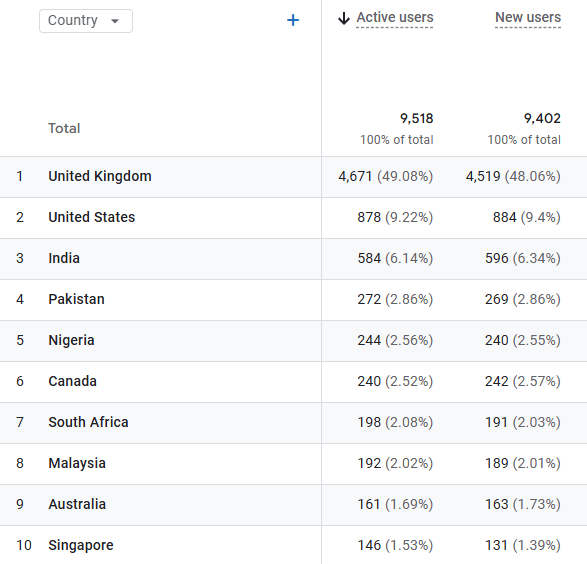
That gives you a general overview but doesn’t allow you to see which website pages those international visitors got to.
The software system that I use (let me know if you’d like a free 30 day trial of that) has a similar view, as you can see below:
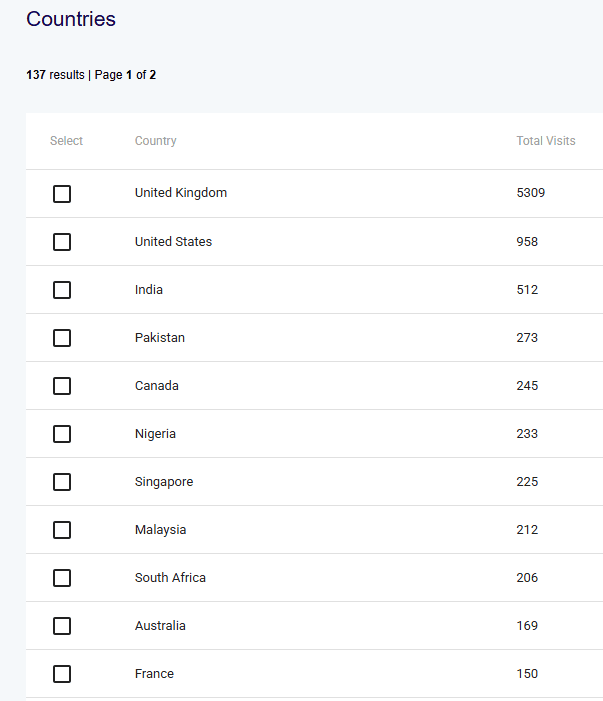
The difference with using this software is that you can dig deeper to see what those international visitors looked at page by page – something you can’t do in Google Analytics.
The example below is showing the page by page movements of one of 260 website visitors from the United States, who got to a specific product page during a one month period:
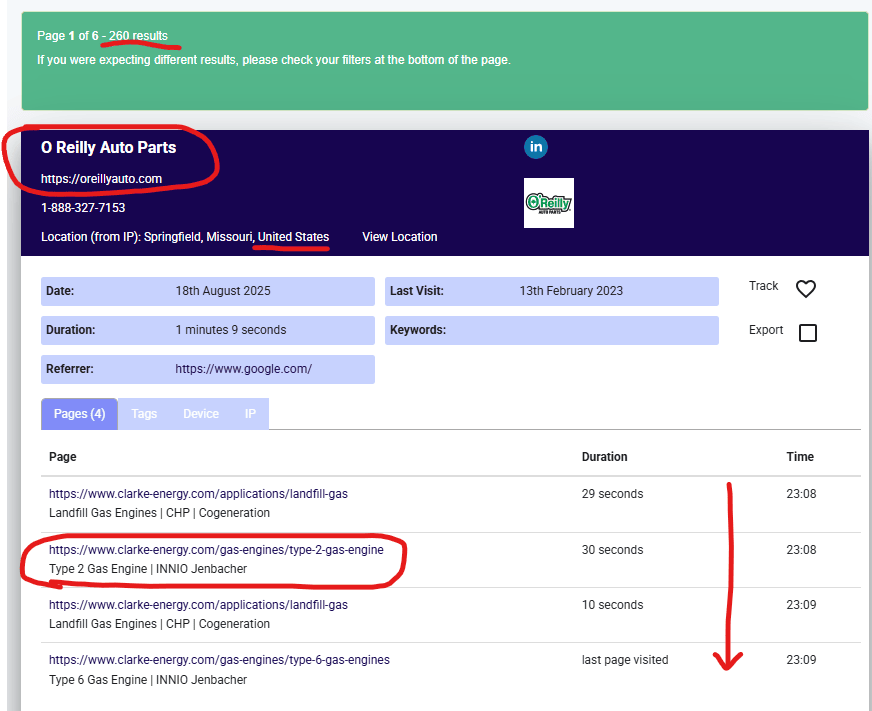
In the example above the business name was identified by the software I use (and can never be identified in Google Analytics), which can sometimes be useful for follow up purposes.
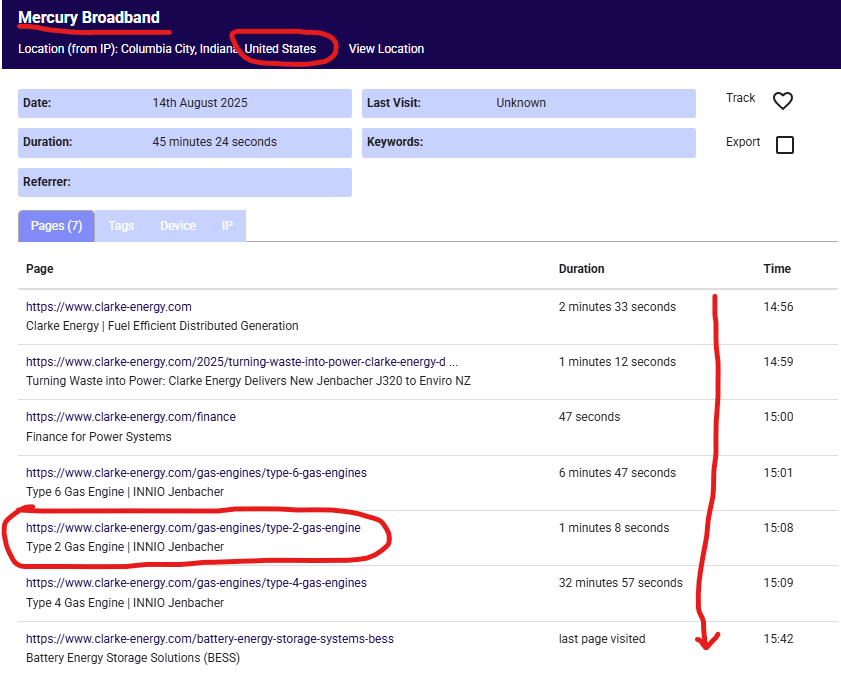
However, that’s often not going to be the case, as you can see from the example below, which shows another United States visitor who looked at several website pages (including the same product), but wasn’t identifiable as a company (it just shows their internet provider – Mercury Broadband).
Many people visit websites from locations and devices that can’t identify them as a company, but they are still potential buyers and so it’s important to think more deeply about them.
The overall purpose of identifying international visitors to your product or service pages is to then focus on those that are more dominant.
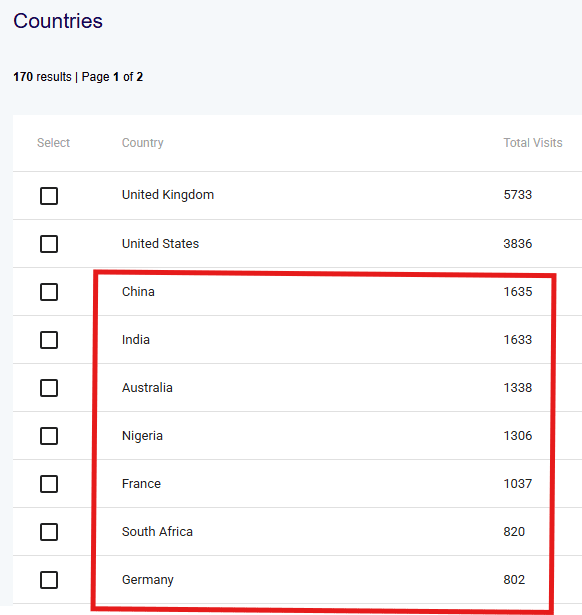
Taking the example below, apart from their home country (United Kingdom), the business has many visitors from the United States, but also sizeable visitors from other countries, as outlined in red …
If people from other countries are going to your website AND you actively want to sell to those people, then awareness of those international visitors is a vitally important starting point.
When you have identified visitors from specific countries that have been visiting your website, you then need to compare those numbers to the level of enquiries you’ve had from potential customers in those countries.
It’s likely to be a very low percentage.
You’ll also likely see that many international visitors go no further than the one website page they landed on.
Here’s why …
They may be interested in the type of service that you offer but most of them will also be thinking:
“How well have they served customers from my part of the world?”
They will likely be on your website and will see contact details that relate to the country where you’re based.
Their first thought may be:
“Do you only supply to businesses within your own country?”
The visitor may look around for examples of the work done for your clients, but even if they find that within your website, they are still looking for evidence of how you have served businesses in their own part of the world.
My recommendation is for you to pick a country and step into the shoes of someone from another country, and look closely at a product or service page that they may have visited on your website.
Does that page have a very clear call to action that invites them to click through to information about work you’ve done for customers around the world?
The answer, for most websites, is: No.
That’s when you’ll lose them because they don’t want to invest time in looking at a business that can’t prove that it’s successfully served businesses in their part of the world.
Even worse is that AI searching makes it easy for people to be very specific about what they’re looking for and if your website doesn’t have the required international focus, then you will lose out to competitors that do (and so become visible in AI search results).
An example: someone searches for: ‘gas engine suppliers who have customers in France’ and the search system (whether Google or an AI engine) is going to present information that best-matches what the person wants to find. That person does not want to look at loads of websites to find potential suppliers that have served others in their part of the world – AI searching makes it very easy for them to find what they are looking for.
I’m not going to suggest you put a ton of resources into making your website multilingual.
While that would be beneficial, it is a large undertaking that could be done when budget and time allows.
Shorter-term, you can impress international visitors in other ways because (right or wrong) English is a well-understood language by many around the world, plus Google Translate also makes it easy for people to get localised translations of your website content.
Here’s the step by step guide of how to do that …
From your portfolio of historic work , extract all work done for customers from other countries. All you need at this stage is this information:
You’re aiming to build up a document that will show strengths and weaknesses.
For example, you may have these levels of work done within Europe:
Belgium: 1 client
France: 2 clients
Germany: 4 clients
Spain: 1 client
All other European countries: 0 clients
If your website visitor statistics are showing that you have good levels of visitors from Italy, but you have never done any work for companies there, then you’re not in a position to create case studies to impress those Italian visitors.
However, you ARE in a position to create case studies related to European clients overall, which may be enough to convince Italian visitors that you have had success with clients in their part of the world, even though not their specific country.
For most businesses, it’s unlikely that you will have case studies for most countries in each region, but you could build those up over time.
What I’m recommending here may appear to be a half-hearted attempt at international focus, but it has two purposes:
Look at one of your product or service pages on your website, ideally one that already has good levels of visitors, including those from other countries that you could serve.
The international website visitor is looking for a reason to keep engaging with your website, and then to make contact with you.
That reason needs to be a clear graphic within the product/service page, inviting them to click on it to see case studies of clients around the world.
For example, a graphic containing a world map and with a call to action message of:
Click to see examples of our customers worldwide.
That simple graphic says to the international visitor: “they don’t just supply to their own country”, and so they are likely to click on that graphic.
Clicking on that graphic would take them to a website page that focuses on case studies, but in a very simple way.
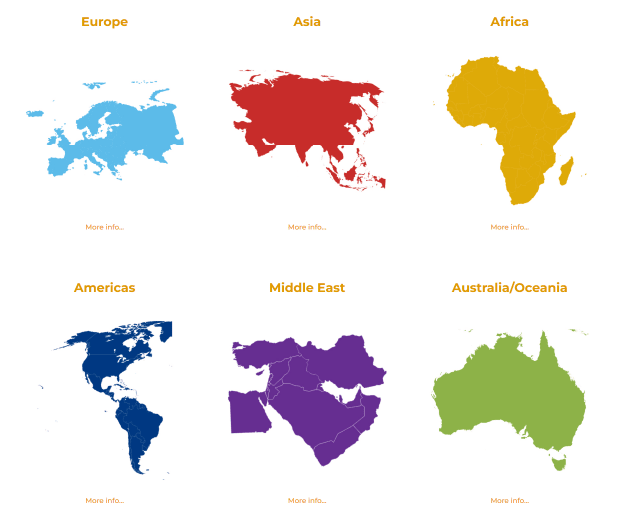
What international website visitors would see is an opportunity to click deeper into their part of the world. Here’s an example:
By clicking on that deeper level, the website visitor will then be within a part of the website that does one of two things (depending on how many case studies you have):
It’s likely that most companies will go for option 2 above, until they have more country-specific case studies to include.
The case study excerpts will act as brief introductions to each case study that people will see when they click through.
Important elements to include in each excerpt are:
That will give enough information for people to want to click through to the detailed case studies.
This is where you may be thinking:
“Hang on, I haven’t got time to create tons of in-depth case studies”.
Here’s the good news: you don’t have to … yet!
Each client case study page needs to contain one thing only: a very brief paragraph about the work done for that client.
Nothing more.
Here’s why …
Your aim is to impress international visitors but not at the expense of embarking on a huge project that will eat up lots of time and resources.
By creating a path that international visitors can click through, you are building up data in your analytics that will dictate which case studies need more focus over time.
Here’s an example …
You’ve identified that you had 100 website visitors from Italy during a month (who got to your product or service pages).
Each of those visitors would have seen the graphic that invited them to look at case studies of your worldwide clients.
30 of those 100 visitors clicked through to your worldwide clients page and then clicked through to the Europe page, where they would see some case studies from Italy but also many others from other parts of Europe.
The website analytics data shows that only 5 clicked through to individual case studies.
That’s 5% of the total website visitors from Italy.
Your data also shows that you had less visitors from Germany (50) during the same month (who got to your product or service pages).
Again, they had the opportunity to click on the graphic to look at case studies of your worldwide clients.
20 of those visitors clicked through to your worldwide clients page and then clicked through to the Europe page, and 5 of those 20 clicked through to individual case studies.
That’s 10% of the total website visitors from Germany, even though it’s the same number of 5 people who clicked through as those from Italy.
That higher percentage could mean that the German visitors chose to dig deeper more, and so you may want to focus more on them.
However, whether they were German or Italian, those international visitors would still have clicked through to individual case studies that were very basic (one paragraph), and may not have been impressed enough to make contact.
This is where you expand your focus in this way:
By adopting the method above, you are focusing on the case studies that seem to get more clicks, instead of those that have no or low clicks.
This way you can create numerous case study pages related to numerous countries in a very minimal way, but only focus more attention on those pages that are actually getting website visitors traffic.
If you identify useful levels of visitors from countries that you have done no work for, you’re in the position where there is no trust to enable you to get the work that you could turn into case studies.
Although not strictly ethical, this strategy could be applied:
However, a fake and anonymous case study will never be as strong as a real case study, so you should be aiming to gradually replace each fake case study with a real one, as you build business in that part of the world.
Using detailed analytics (including the software I’ve referred to on this page) you can often link enquiries back to what led to those enquiries.
For example, you get an enquiry from a company in Italy on a certain date and time. You can then look back at your analytics data to identify that visitor and what they looked at page by page.
When you see evidence that the international enquiry was facilitated by you having case studies related to their part of the world, that’s what incentivises you to accelerate your pace of international focus.
When you get to the point where you have individual case studies that are more popular, you have the opportunity to utilise the skills of multilingual professionals to convert those case studies to their language.
A word of caution here: while Google Translate may seem like a free option, it won’t always consider how to translate the information in ways that are truly understood by the international reader. All they will see is that you have cut corners instead of respecting their language/culture by getting the translation done properly by multilingual professionals.