
Google AI Mode is now (as at August 2025) available in the UK.
It allows people to search in the same way they have used ChatGPT or Perplexity – directly within Google.
This will lead to big decreases in enquiries for some, and big increases in enquiries for others.
If you are not visible in searches made within Google AI Mode then you’re in for a tough time!
The brilliant news is that every business has huge opportunity to be visible, and this article includes tips that will help you to achieve that.
Someone searches Google.
They scroll down and click through various websites trying to find something that answers the questions in their head.
They eventually find a business to engage with.
Time taken: ages.
Frustration factor: high.
Along came ChatGPT, then Perplexity … and others.
They let people search for something and then refine their search without having to go to loads of websites.
Time taken: short.
Frustration factor: very low.
ChatGPT has over 1 million downloads a day, including people who want a better search experience than Google historically provided.
Google AI Mode gives people what their AI competitors have been offering for ages – the ability to find what they want quickly.
This video shows you just how easy it is to find something using Google AI Mode.
My prediction: by the end of 2026, very few people will scroll down Google search results, or the Google search system may have changed structure completely.
It’s not at all unfeasible that Google will kill off pages of search results, instead allowing people to keep refining their search via AI Mode (which is likely to become the main way Google works, rather than being called something separate). You can see more about my predictions for how Google search may evolve in the next year here.
In short: it’s critical for you to be highly visible within Google AI Mode searches, because most people are familiar with using Google to search (vs ChatGPT etc.).
Whether Google AI Mode, ChatGPT, or anything else, searches that use AI are taking all these factors into consideration, of which your website content is one – although an important one:
While this article focuses primarily on actions you can take within your website, it’s important to be clear: your website is just one piece of the puzzle when it comes to AI search visibility. It’s a crucial piece, yes – but not the only one. The guidance here is centred on strengthening your website because it’s the area you have the most direct control over, and improving it can significantly boost your chances of appearing in AI-driven search results including Google AI Mode.
If we assume that Google AI Mode will become the way that Google works, then we have to take it very seriously – especially if Google decide to completely remove all the other organic search results at some point.
Here are facts that are difficult to argue against:
The current (August 2025) position is that ChatGPT, Perplexity etc. can show your business when people type very specific results.
Although you still want that visibility, what ultimately matters the most is being visible in the one place that most people go to: Google.
And that means being visible in Google AI Mode results, not somewhere down the traditional search results or just in the AI Overviews.
People will initially use Google AI Mode in a simplistic way.
For example, they may type a simple ‘accountants in Maidstone’, look at the search results, and then type a follow up, such as ‘that have experience with engineering businesses’. They may then add on another follow up question, such as ‘and show pricing on their website’ and/or ‘that have good reviews’.
As they update their search they will see the results update and potential supplier names will change in line with what they add onto their search.
This simplistic way of searching will change, and within the next year, people will know to be very specific with their initial search. Using that example above, they would type it into one search such as:
Accountants in Maidstone that have experience with engineering businesses and show pricing on their website and have good reviews.
Those that focus on being visible for what people care about, are those that will get the visibility and clicks.
Currently (as at August 2025), the AI systems tend to present searchers with more options in the results, even when they’re not a precise match for the intent of the searcher. What’s likely to happen in the future is that the AI systems (including Google AI Mode) will get more intelligent and will show a more refined view.
For example, if someone is specific about their searches and only one or very few websites match the search intent, then Google and others may not bother showing additional options for people to consider – because they’d not be a close enough match.
Now it’s time to look at what (apart from off-website AI visibility factors) you can do to maximise your ability to be highly visible in Google AI Mode (and, implicitly, what Google main search will become in the future) results …
Becoming highly visible in Google AI Mode results includes focusing your website content on these core areas of interest to people who are searching – while all are important to be aware of, you have the option to click down to the topic of most interest to you:
Each service/product you offer needs a dedicated website page.
Many websites compromise by combining those services/products within one page, which isn’t sufficient/targeted enough.
Taking accountants as an example, there should be individual service pages for:
Each of those pages needs to briefly summarise what’s being offered and then showcase brief excerpts of clients (named or, if necessary, anonymous), so that people (and AI engines) see that you have provided services/products to clients. At least 9 showing on the page and an option to expand into more, these all link to detailed case studies that provide more depth into how you helped them with that specific service/product.
For example:
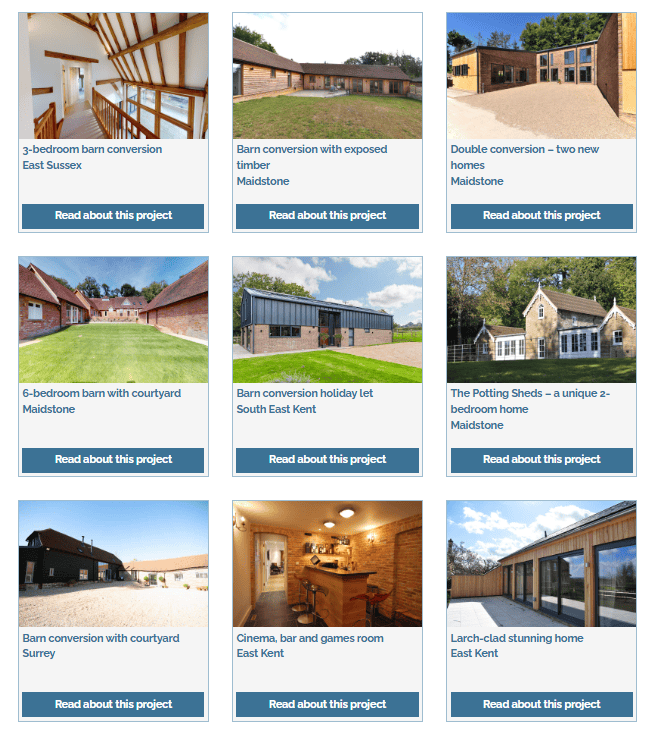
If you have testimonials from clients, related to the specific service/product, then include them on the page.
You can see a lot more on how to create this type of structure by looking at my page focused on how many case studies to use on a website and where to place them.
When structured correctly, each service/product page will briefly describe what you provide, show lots of evidence of how you have done that for clients, go into more depth on the service after that, and ultimately give AI search engines lots of what they need to make you visible.
Go to Google and type this, swapping out the bracketed parts for what you offer (and varying it as would be appropriate to your services/products):
[Your service] experienced in working with [Their business type] and can help with [Specific niche within what you offer overall] and that have client examples from my sector on their website.
Example: Accountants experienced in working with engineering companies and can help with corporation tax time to pay and that have client examples from my sector on their website.
Then click on the AI Mode button and see what appears.
People want to know how much (or at least get an indication of how much) something costs.
Many websites don’t provide this information, and you’ll see my strong views on that short-sightedness in my article on why you need a pricing page even when not showing your pricing page that goes into a lot more detail.
An overall pricing page is essential to have highly visible (in your main navigation bar) and what it contains can vary, depending on your types of services/products, but they should be clearly displayed within that page, including exact or ranges of pricing for what you offer.
There can be no exceptions to this rule – humans expect pricing transparency and you will be invisible in Google AI Mode searches if you don’t respect that.
You should also ideally include service/product-specific pricing within those service/product pages of your website. As a compromise, you could (on those pages) have a highly visible ‘See pricing of [name of service/product]’ button or bar that clicks through to the associated anchor point on your main pricing page.
Go to Google and type this, swapping out the bracketed parts for what you offer (and varying it as would be appropriate to your services/products):
[Your service] in [Your geographic location] that have clear pricing on their website.
Example: Accountants in Maidstone that have clear pricing on their website.
Then click on the AI Mode button and see what appears.
That example above is very simplistic and in reality, people would search on pricing in combination with other factors (e.g. accountants in Maidstone with clear pricing and expertise in the small shop retail sector).
This is an amazingly simple win for most businesses to achieve because most aren’t doing it, and you could be the only Google AI Mode search result that appears when people are precision-searching!
If you work with specific sectors then you can be highly visible in Google AI Mode searches when people are being specific in their search requirement.
Think about it logically – if a searcher is looking for a service/product and they work within a specific sector, then they want to find people with related sector experience.
What you need is a Sectors (some may call it Industries) section of your website – including placing that in your main navigation bar. That will sub-divide into individual pages dedicated to each business sector you can help.
Each of those individual sectors pages (e.g. aerospace, defence, education, etc.) would start with a brief introduction to how you help them, but would quickly include excerpts of clients you’ve worked within from that sector – and as many of those as you can possibly include.
Below that proof of your expertise you would focus on more detail about how you can help people from within that business sector.
This sends out strong signals to humans (and AI systems) that you should be visible in the results.
To see a lot more depth about how a sectors part of your website should work, please see my page about sectors, which includes visual examples.
Go to Google and type this, swapping out the bracketed parts for what you offer (and varying it as would be appropriate to your services/products):
[Your service] with experience in [Their sector] and who have examples of related case studies on their website.
Example: Office refurbishment companies with experience in the education sector and who have examples of related case studies on their website.
Then click on the AI Mode button and see what appears.
That example above is very simplistic and in reality, people would search on pricing in combination with other factors (e.g. Office refurbishment companies in London with experience in the education sector and who have examples of related case studies on their website, including costs of refurbishment projects).
Short-term, if you get it right, there may be few competitors appearing in Google AI Mode results for what you offer. But that won’t last forever and you could be appearing amongst other results that appear for the same types of searches.
For example, if someone searched for ‘VAT accountants in Maidstone with good reviews’, there could be several results appear.
If people haven’t been specific enough in their search requirements, they are still not sure which website to click through to and so they may ask a simple follow up question such as: ‘which of those is the best?’.
It’s a subjective question of course, but is a golden opportunity for you to be visible by having a website page focused on your USPs (Unique Selling Points). You wouldn’t name it that – something like ‘Why Choose Us?’ would be best, and for that to be highly visible in your main website navigation bar.
Within that page you have two objectives:
Forget generic statements such as:
“We provide great customer service” (well, who wouldn’t!)
“We’ve been in business for over 10 years” (which doesn’t mean much)
“We offer competitive pricing” (which you’d expect anyway)
“We deliver on time and on budget” (you’d be rubbish if you didn’t!)
“We’re fully qualified and insured” (qualified and insured in what ways?)
For each USP you think of, if it could apply to your competitors, then don’t include it.
It’s better to have fewer unique USPs than generic ones that people could look at and think “so what!”.
Your page needs to include wording that thinks like a human (and also would appeal to an AI engine who has to answer such questions about who should be chosen out of a bigger range of search results).
For example, if you are an accountant then you will do the same as most accountants, so you really need to stand out when someone asks Google AI Mode for which is the best.
As an accountant, your page could start off with a statement similar to this, followed by your USPs …
There are many accountants in Maidstone, so how do we stand out from the others?
Here are some of the reasons why our clients think we’re the best choice of accountant for them, and are also points to consider if you are considering other accountants …
Go to Google and type this, swapping out the bracketed parts for what you offer (and varying it as would be appropriate to your services/products):
[Your service] in [Geographical area] with the best reviews
Example: Business coaches in Manchester with the best reviews.
Then click on the AI Mode button and see what appears.
THEN add an additional search of: how do I choose which of those is the best?
People have long known that they can search Google for a service or product provider in their geographical area, but they have historically still had to wade through lots of websites.
With Google AI Mode this is made easier for them because they can add context to their geographic search.
If you serve specific geographic areas then there are two approaches to this:
That first point is the way it’s been done for years – websites create a page that is engineered to be visible in Google results. For example: gardeners.co.uk/gardeners-in-maidstone.
That still works, but its days are numbered because AI will get more intelligent and see through such tactics.
It’s far better to find natural ways to focus on geography within your website pages.
The earlier recommendations on this page have already provided the groundwork for this in these ways:
It is of course also important to ensure your business address is always in the footer of your website, on your contact page, and that it precisely matches the format of that same address and phone number shown on your other visibility (e.g. your Google Business page, Facebook, Yell.com etc.).
Geography is less of a concern than other factors that will help your website be visible in Google AI Mode results, because AI is already quite good at working out the areas that people serve.
You may find this is less of a problem but it’s worth testing out.
Go to Google and type this, swapping out the bracketed parts for what you offer (and varying it as would be appropriate to your services/products):
[Your service] in [Geographical area]
Example: Physiotherapists in Brighton
Then click on the AI Mode button and see what appears.
However, people typing such a geographic search will be in the minority so you need to think about the other things people will type in alongside their basic search, so it’s worth you expanding on your geographic search in Google AI Mode.
Taking that example above, expand it out to:
Physiotherapists in Brighton who can help relieve pain from a back injury that happened from a manual lifting strain at work, and have positive customer testimonials.
Outside of the core pages within your website, blogs create a great opportunity for you to be visible for very niche topics when people are searching for them.
Here’s an extremely niche example:
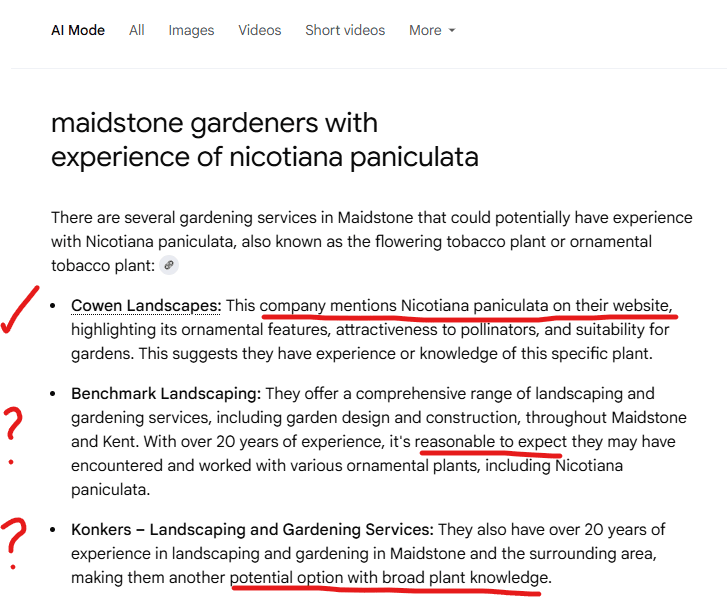
That search phrase is very niche but the overall geographic presence of that top positioned gardening business, in combination with a blog they wrote on the topic of Nicotania Paniculata puts them in a good position compared to the other results because Google AI Mode seems obliged to show additional results even if there’s not a definite match.
Because of the niche nature of that search, a broader search on ‘Kent gardeners with experience of nicotiana paniculata’ also surfaces their blog so that someone elsewhere in Kent who really wants an expert, and is prepared to pay more for the service, could make contact:
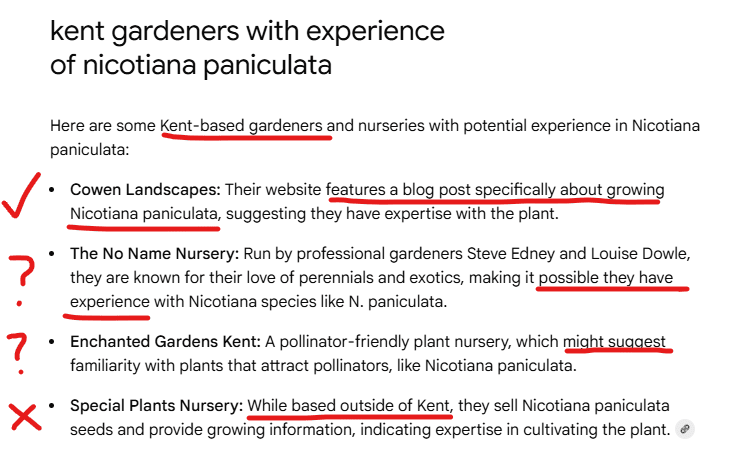
That example is extremely niche and reality is that very few people would type such things – but you will be able to find niche blog topics that are a bit broader and would bring really strong leads to you.
As I said earlier, being visible in Google AI Mode is not purely about the strength within your website.
While this shouldn’t be considered a full list, here are some additional activities you can consider that will also help support your visibility:
Currently, there is no way to easily know what specific search phrases (or types of phrases) are making you visible (or not!) in Google AI Mode results.
That type of software/service will appear (I’d be surprised if it hasn’t been made available at an affordable price before mid-2026) but in the meantime you need to put in the effort to see where you are missing opportunities.
My recommendation is to either officially or unofficially encourage people you know, including those in your business who really should care about your company being more visible than others – because it protects their jobs – to be actively using Google AI Mode (and other systems like ChatGPT, Perplexity etc.) to search on things that you would ideally be visible for.
It’s important to think outside the box as well – the saying ‘the riches are in the niches’ is very true here!
Is it feasible that someone could type something like these as search phrases? …
Putting yourself into the shoes of people who have very specific requirements enables you to create website content that perfectly matches what they are looking for and, currently, you could easily be the only viable search result that appears in Google AI Mode output.