
The way people search has changed enormously.
The place where most people start searching has not.
Google has not been replaced by ChatGPT, Perplexity or other AI platforms. Instead, Google has absorbed the threat by placing AI-generated answers inside the search results billions of people already use.
For businesses, this creates an important distinction.
It’s important to take visibility within ChatGPT, Perplexity, Gemini and other AI platforms seriously, BUT you should not become so distracted by them that you neglect Google.
Google remains the biggest opportunity to put your business in front of people who are actively looking for help.
By a long long way.
As at August 2026, Google currently accounts for more than 91% of worldwide search engine activity. Google AI Overviews are also reported to reach approximately two billion people each month.
ChatGPT has more than one billion active users, while Perplexity reportedly has around 45 million monthly active users. Those are substantial audiences, but the numbers should not be compared without understanding what people use each platform for.
People use ChatGPT for many purposes, including:
Some of those uses involve finding companies, products or services. Many do not.
Google searches are different because a large proportion begin with someone actively looking for an answer, product, service or business.
That means your priorities should really be:
My view on this is:
Don’t ignore the smaller AI platforms, but beware trying to capture 100% visibility within a puddle while ignoring 1% of visibility within the Google ocean.
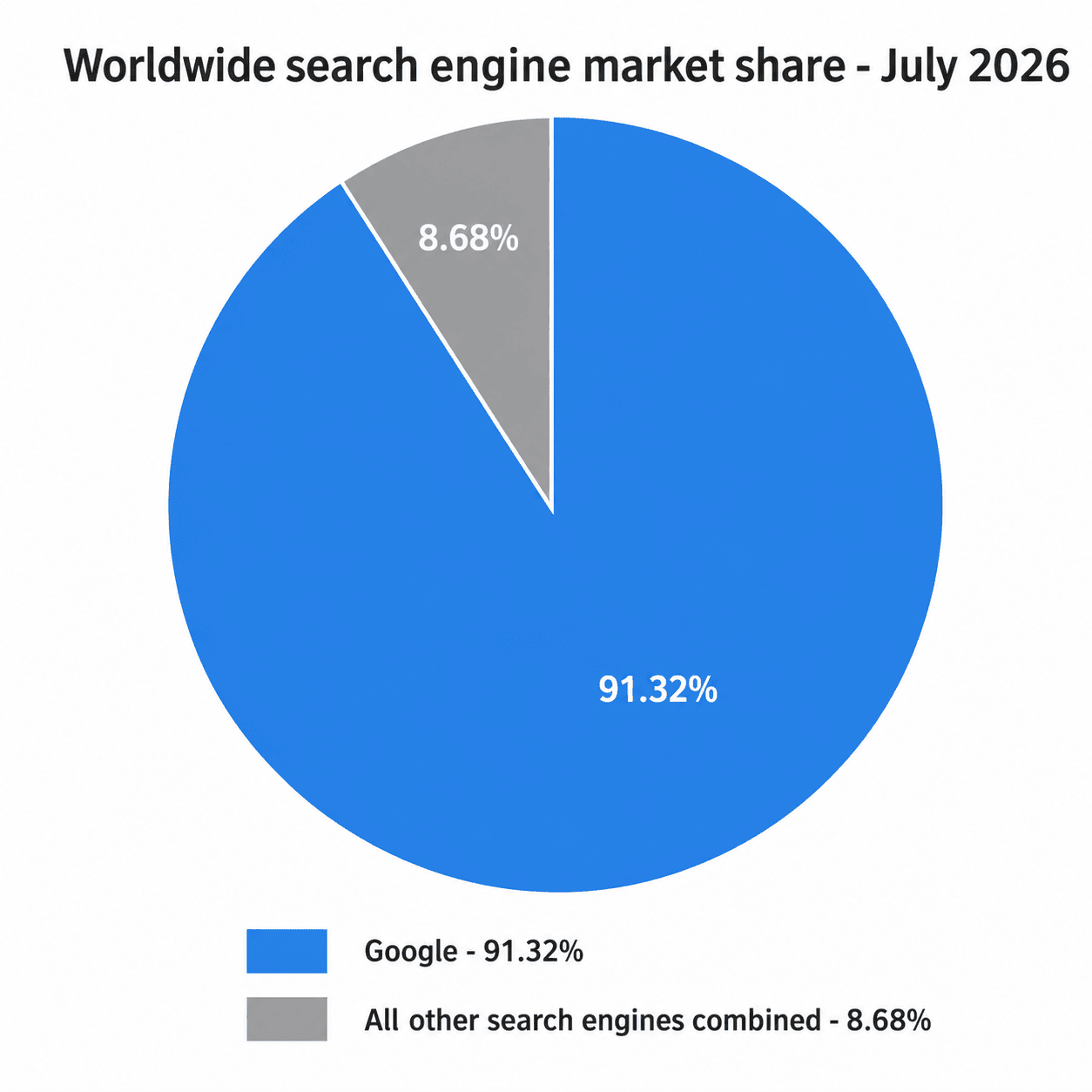
Statcounter recorded Google with 91.32% of worldwide search engine market share in July 2026. Bing accounted for 4.46%, with the remaining share divided between Yahoo, Yandex, DuckDuckGo, Baidu and others.
A few years ago, there were confident predictions that ChatGPT would dismantle Google.
The traditional list of blue links was soon to be finished. People would abandon search engines and use AI chatbots as the new front door to the internet.
I was one of those predicting it, based on the woeful job of AI that Google was doing at the time.
Those predictions were half right.
People are increasingly comfortable asking detailed questions and expecting direct answers. They are using AI to compare options, summarise information and support buying decisions.
However, the front door remains largely where it was before – Google.
Google did not need to persuade billions of people to form a new habit. It added artificial intelligence to an existing habit.
Someone can type a question into Google without consciously deciding to use AI. Google can then place an AI Overview above the traditional search results.
That default position gives Google an enormous advantage.
This reminds me of the Google versus Bing battle.
Bing was not necessarily a bad search engine. It had useful features, strong technology and the financial backing of Microsoft.
It also had loyal users.
However, businesses did not normally divide their search engine optimisation budgets equally between Google and Bing.
Why would they?
Google had the scale. If a business ranked first on Bing but was almost invisible on Google, the Bing success rarely compensated for the missed Google opportunity.
The same principle applies to AI visibility.
ChatGPT and Perplexity are very good products. Perplexity is particularly useful for detailed research because it normally presents its supporting sources.
But people must actively choose to use those platforms.
They open another app, visit another website or consciously change the behaviour they have used for years.
Google does not have that barrier. Its AI answer appears inside the search experience people already know.
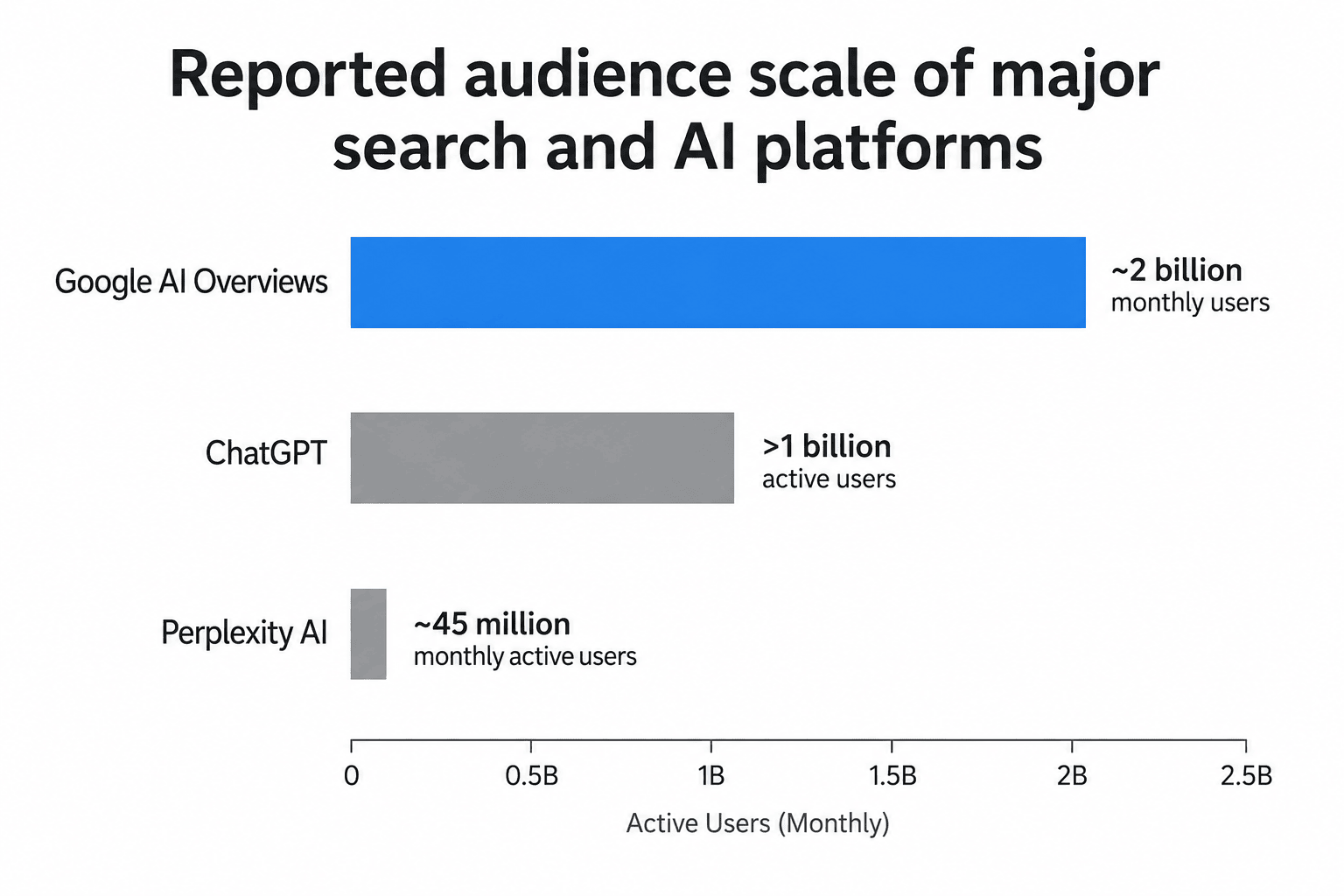
Google has said that AI Overviews reach two billion monthly users. BrightEdge also reported that more than three billion people collectively interacted each month with Google AI Overviews and ChatGPT by March 2026.
OpenAI stated in August 2026 that its models reach more than one billion active users. Earlier in 2026, OpenAI reported more than 900 million weekly active ChatGPT users.
DemandSage reports that Perplexity has more than 45 million monthly active users and approximately 170 million monthly website visits.
These figures demonstrate that standalone AI platforms cannot be dismissed.
However, they are not directly comparable.
Google AI Overview users, ChatGPT active users, Perplexity monthly users, website visits and search engine market share are different measurements.
Figures use different reporting methods and show indicative platform scale rather than direct market share.
ChatGPT reaching more than one billion active users is an extraordinary achievement.
However, it would be a mistake to assume that those users are carrying out one billion sets of product and service research.
OpenAI describes people using ChatGPT to learn, write, plan and build. Its research into consumer behaviour also covers practical advice, writing and information-seeking rather than commercial search alone.
Consider someone who uses ChatGPT 20 times during a working day.
They might use it to:
That person counts as an active user.
However, none of those prompts necessarily involved looking for a company to buy from.
Someone who searches Google for “commercial flooring contractor near Birmingham” has a very different purpose.
They are looking for help. They may be comparing suppliers, checking capabilities or getting closer to making an enquiry.
This difference between usage and intent is easily overlooked.
Do not assume that a platform with hundreds of millions of active users will generate the same quantity of commercially useful opportunities as Google.
ChatGPT has a huge and rapidly growing user base, but Google continues to dominate measured worldwide search activity.
Statcounter publishes a specific Google versus ChatGPT activity comparison.
Its July 2026 worldwide figures were:
ChatGPT is significant. It just has a different place in people’s lives and buying journeys.
Omnibound reports that Google AI Overviews appear for approximately 48% to 50% of US Google searches, and while that’s not UK data, it’s still a big number likely to be similar in other countries.
That does not mean half of every business’s important searches will produce an AI Overview.
The percentage will depend on:
A solicitor, manufacturer, online retailer and local plumber will not experience AI Overviews in exactly the same way.
The sensible response is to inspect the searches that matter to your business rather than relying solely on an industry-wide average.
For years, businesses focused on getting into the first few traditional organic positions.
That remains useful, but the page has changed around those positions.
An AI Overview can occupy a large section of the screen before someone reaches the standard organic results. On a mobile device, those traditional listings can be pushed much further down.
Research summarised by HigherVisibility suggests that the click-through rate for a first-position organic result can fall from approximately 28% to 35% to around 12% to 15% when an AI Overview appears.
That represents a decline of up to 58%.
Other research has produced different percentages because the results vary by sector, search and research method.
However, the general direction is clear.
When Google provides the answer on the results page, fewer people need to click a traditional listing.
That doesn’t mean search engine optimisation is dead.
It means that ranking position alone is no longer a complete measure of visibility.
Useful for you and your business to know/research would be:
An SEO report showing that you still rank third may sound reassuring.
It becomes much less reassuring when an AI answer, shopping results and several other features appear above you.
Google AI Overviews draw from webpages and other sources that Google considers suitable.
That creates a different competition.
You are no longer competing solely to become one of ten blue links.
You are also competing to become one of the limited sources Google trusts enough to use within its answer.
That visibility can introduce your business before the searcher has considered visiting a website.
It can also build recognition over time.
Someone may repeatedly see your company name, research or advice included in AI answers. They might later search for your business directly rather than clicking the original citation.
This makes AI visibility harder to measure than traditional website traffic.
The value may appear through:
A direct click is valuable, but it is not the only possible outcome.
Perplexity can send highly valuable visitors.
Its users often carry out detailed research and may have stronger intent than an average website visitor.
That means one Perplexity visitor could sometimes be worth more than several unfocused Google visitors.
But scale still matters.
Capturing 100% of a puddle is hugely less achieved than capturing 1% of an ocean.
The right approach is prioritisation, not exclusion.
Google should normally receive the greatest attention because of its reach and its position inside existing buying behaviour.
You can then measure visibility and useful traffic from:
I highly recommend that you don’t allocate your effort according to headlines about user growth.
Allocate it according to the visitors, enquiries and sales each platform produces for your business.
There is no guaranteed trick that places your business inside AI Overviews (although there’s no shortage of people supposedly with the answers!).
However, there are sensible actions that improve the quality, clarity and usefulness of your website content.
Many website pages focus on short phrases such as “accountancy services” or “commercial flooring”.
Those pages often fail to answer the questions in a potential buyer’s head.
For example:
Speak to your sales team and record the questions prospects repeatedly ask.
You can then create pages that answer those questions properly.
Declining are the numbers of people who search for something and spend ages looking through websites.
Ascending are those who type very specific searches (e.g. ‘commercial flooring companies in Manchester with case studies of work done in the finance sector and timescales of projects undertaken’).
If you’re not visible and others are, you’ll experience that in the form of declining enquiries and people around you saying “there’s a downturn”, not knowing that you’re losing prospects via invisibility.
AI systems have little reason to cite you when your article rewrites information already published elsewhere.
Your strongest material is information competitors cannot easily copy without referring back to you.
That could include:
In my case, I have analysed more than 6,300 websites.
The patterns and evidence from that work are more valuable than another generic article repeating basic conversion advice.
Your own experience is where your authority lives.
A very simple task for you is, each day or week, audio record yourself talking about all the work/jobs etc. you’ve been doing for clients, plus other things that are relevant to your industry. Then (via AI of course) get transcriptions of those thoughts – you can talk directly into ChatGPT of course – and turn them into content that comes from the heart and separates you out from the ‘vanilla’ of your competitors.
A brilliant answer hidden inside a huge block of text creates unnecessary work for people and machines.
Use clear H2 and H3 headings. Break processes into numbered steps and use tables where people need to compare options.
Start sections with a direct answer before expanding on it. People (and AI) hate longer meandering descriptions of things when they just want to know the outcome/summary and then have the option to read in more detail.
That approach helps website visitors scan the page. It also makes the subject and structure clearer to search engines and AI systems.
Being mentioned by an AI platform may feel good, but visibility is not the final objective.
The objective is more enquiries, sales and revenue.
Monitor:
Don’t let an attractive AI visibility chart become another vanity report.
I help businesses understand why their websites and marketing are not producing enough enquiries and sales.
That includes helping them with the strategies that will make them visible in the right places at the right time.
I have many free resources for you to get more of a feel for me, and if you want to dip a toe in the water of how I could help you, please do look at my services that range from very low cost commitment through to the work I do for clients that are looking for much bigger results from their websites and marketing.