
Getting more from your existing website and marketing spend is rarely about doing more. It is usually about understanding where things are breaking down. Whether you are seeing traffic without enquiries, or leads that go quiet before they convert, the answer almost always sits somewhere in the customer journey. Read on for a practical guide on how to improve your sales funnel and turn more of your existing traffic into results.
A sales funnel is a way of mapping the journey a potential customer takes from first becoming aware of your business through to making an enquiry or purchase. For businesses trying to get more from their website and digital marketing, this framework is useful because it shifts the focus from individual tactics to the full sequence of steps a visitor goes through before they convert.
Without a structured view of that journey, it is easy to invest in traffic generation while ignoring the parts of the website that are losing people. The funnel gives you a way to see the whole picture.
The sales funnel describes the narrowing path from a large pool of potential visitors down to a smaller group of paying customers or enquirers. At the top, you have people who are just becoming aware of your business. By the bottom, you are left with those who have taken action.
The term “funnel” reflects the reality that not everyone who finds your website will convert. The goal is not to change that fact, but to reduce unnecessary drop-off at each stage and ensure the right people are progressing through.
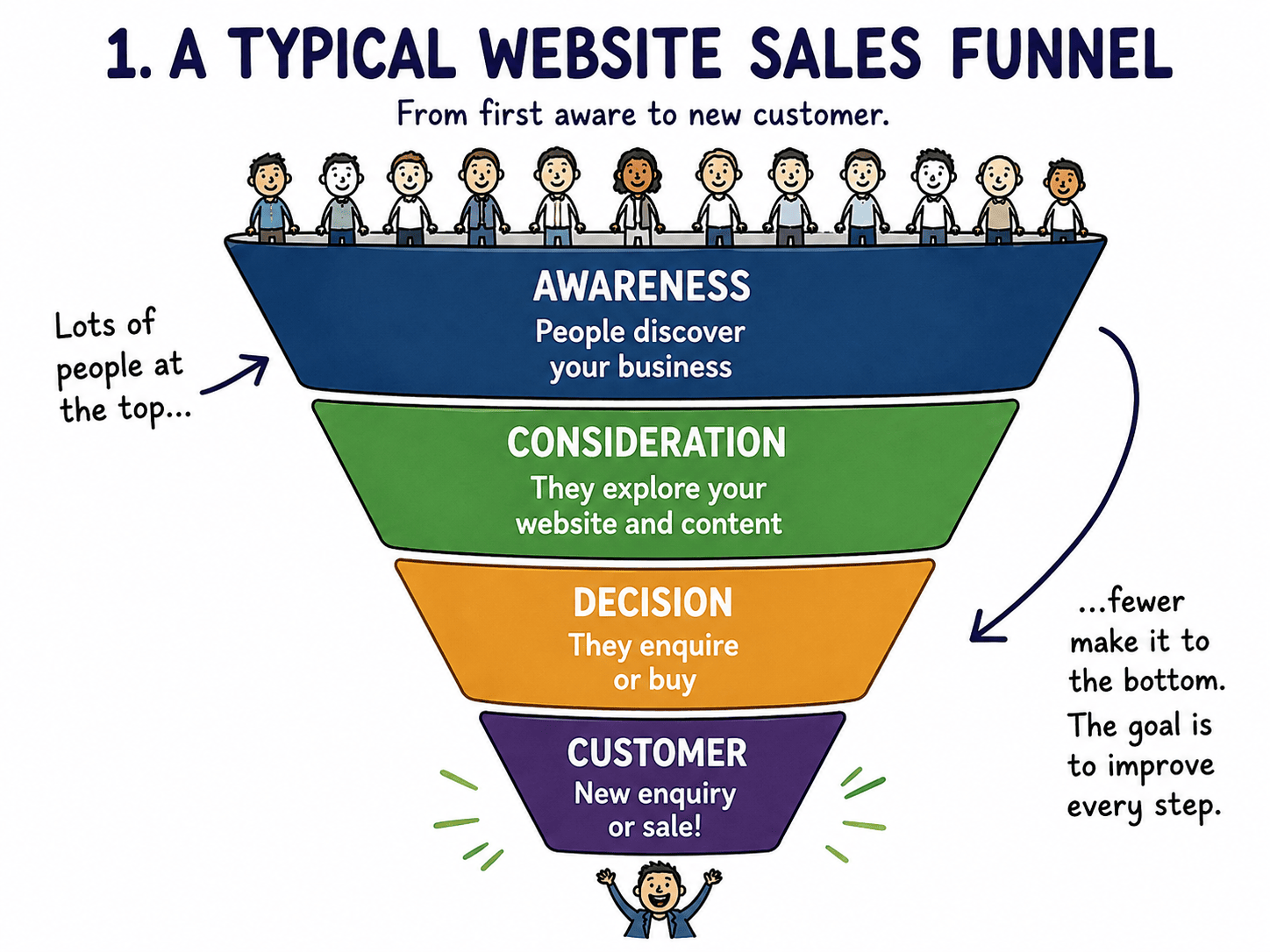
When your funnel is working well, your marketing spend goes further because you are not just attracting visitors, you are converting a meaningful proportion of them. You also gain clarity on which parts of the customer journey are performing and which are not.
For businesses with an existing website, this matters because it removes the guesswork. Instead of assuming a campaign is underperforming, you can see exactly where visitors are leaving and address that specific point.
In B2C funnels, the journey from awareness to purchase is often short. A visitor might find a product page, read a few reviews, and buy within minutes. The website does most of the work, and the focus is on removing friction at the point of purchase.
B2B funnels are typically longer. A potential client may visit your site several times, read case studies, compare options, and request a conversation before committing. This means the website needs to support a more considered decision-making process, with content and touchpoints that hold attention across multiple visits rather than pushing for an immediate transaction.
Here’s more on the conversion time differences between B2B and B2C sales funnels.
The funnel is most useful when you treat it as a framework for organising your website pages, content, and campaigns by the role they play in the customer journey. Each stage has a different job, and the levers available at each stage reflect that.
At the top of the funnel, the goal is visibility. This is where people first encounter your business, often through a search result, a paid ad, or a piece of content. Blog posts, landing pages built around search intent, and paid search campaigns all sit here.
Their role is not to convert immediately. It is to attract the right kind of visitor and give them a reason to stay or return. Driving traffic to your sales funnel starts here, and the quality of that traffic shapes everything that follows.
Once someone is aware of your business, the middle of the funnel is where they decide whether you are worth considering. This is where service pages, case studies, comparison content, and email sequences do their work.
The visitor is evaluating options. Your job at this stage is to give them enough information and reassurance to keep moving forward rather than drifting toward a competitor. Retargeting campaigns (e.g. Google remarketing ads) also play a role here, keeping your business visible to people who have already shown interest.
At the bottom of the funnel, the visitor is close to making a decision. This is where enquiry forms, pricing pages, consultation booking pages, and checkout flows matter most.
The focus shifts entirely to removing barriers. A slow page, a confusing form, or an unclear call to action at this stage can undo everything that came before it. Small improvements here often produce the most immediate impact on conversion rates.
Understanding the funnel concept is one thing. Knowing how your own funnel is actually performing is where the real work begins. This means looking at your website data with a specific question in mind: where are people dropping off, and why?
A funnel audit starts with your website analytics. You are looking at which pages visitors land on, where they go next, and where they leave. The goal is to trace the path a typical visitor takes and identify the points where that path breaks down.
Pay attention to pages with high exit rates that sit mid-journey. A service page that most visitors leave without clicking further is a signal worth investigating. So is a contact page with a high bounce rate, which may suggest the form or the page itself is creating friction.
The metrics that matter most are those tied to movement through the funnel rather than vanity numbers like total page views. Useful indicators include:
These give you a picture of where the funnel is working and where it is losing people before they reach the point of enquiry.
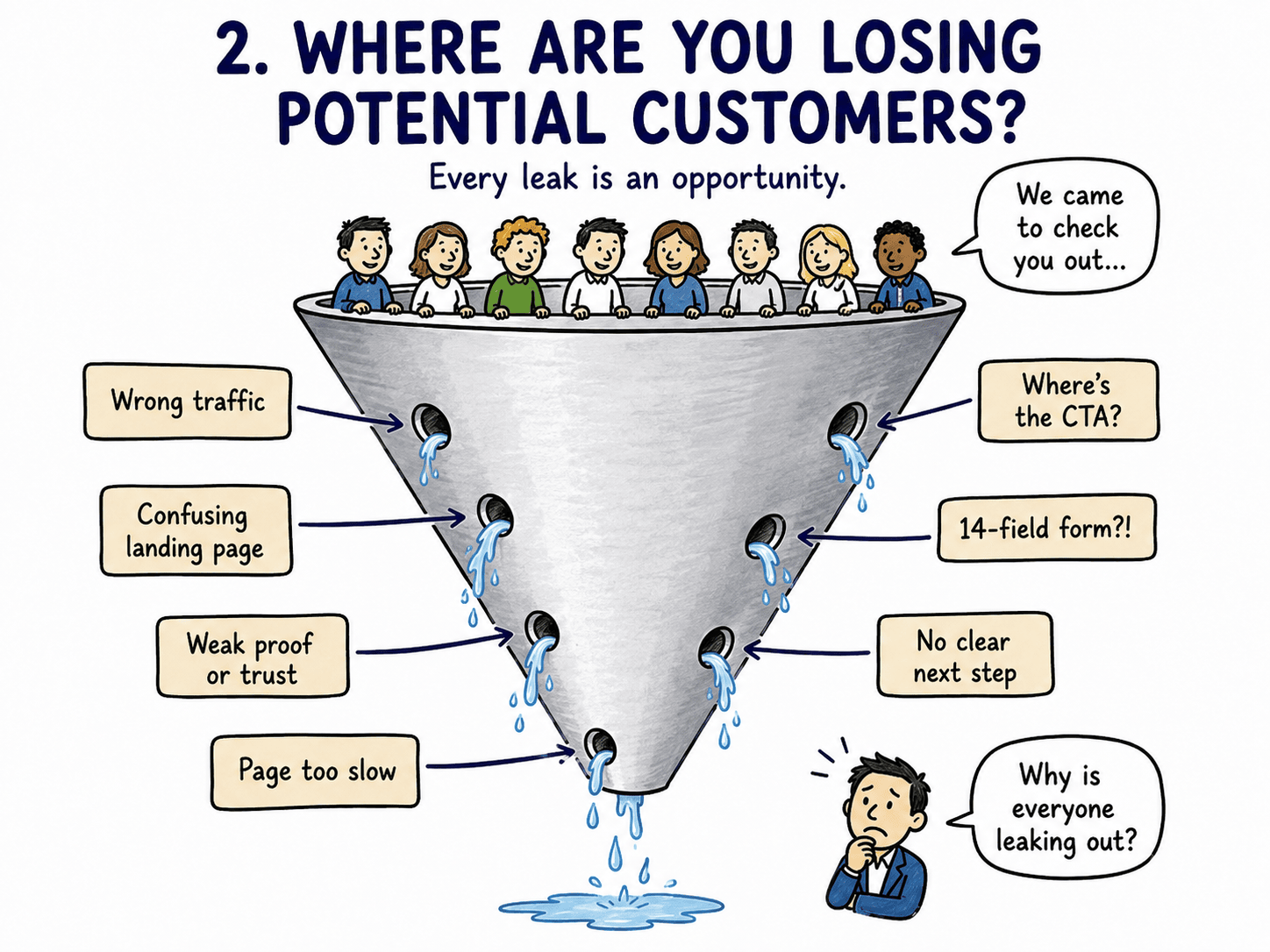
A funnel leak is any point where visitors are leaving when they should be progressing. Identifying them requires looking at the data in sequence rather than page by page in isolation.
Finding and fixing these leaks is a core part of website conversion optimisation – improving the experience so more of the traffic you already have progresses towards an enquiry or sale.
Once you have spotted a leak, the fix depends on the cause. A high exit rate on a landing page might point to a mismatch between the ad that brought someone there and the content they found. A low form completion rate might mean the form is too long or the page does not give enough reassurance before asking for contact details. Fix the specific cause rather than making broad changes and hoping for improvement.
Filling the funnel with traffic is only useful if that traffic has a reasonable chance of converting. Attracting the right people and then filtering them into qualified leads is what separates a funnel that produces results from one that generates noise.
A buyer persona is a structured description of the type of person most likely to become a customer. For businesses, this means thinking about the specific problems your audience is trying to solve, the language they use when searching, and the factors that influence their decision.
This matters for the funnel because every page, ad, and piece of content is either speaking to the right person or it is not. A well-defined persona helps you make that call more consistently across the whole customer journey.
Hubspot have a good article on defining your buyer persona.
Several digital levers are available for bringing relevant visitors into the funnel:
Each of these plays a different role. Paid search delivers volume quickly but requires ongoing spend. Organic content takes time to build up but compounds in value. The right mix depends on your budget, timeline, and how competitive your market is.
Not every visitor who enters the funnel is worth the same level of attention. Lead qualification is the process of assessing how likely a given lead is to convert, based on signals such as the pages they have visited, the content they have engaged with, or the information they have provided.
Lead scoring formalises this by assigning values to different behaviours. A visitor who has read three service pages and returned to your site twice is a different prospect from someone who landed on your homepage and left after ten seconds. Recognising that difference allows you to prioritise your follow-up and tailor the experience accordingly.
Traffic and qualified leads only produce results if the website touchpoints they encounter are doing their job. The mid-to-lower funnel is where conversion either happens or it does not, and the quality of each touchpoint is what determines which.
A landing page has one job: to move a specific visitor toward a specific action. Pages that try to do too much, or that carry over the general structure of the main website without adapting to the visitor’s intent, tend to underperform.
Effective landing pages share a few consistent characteristics:
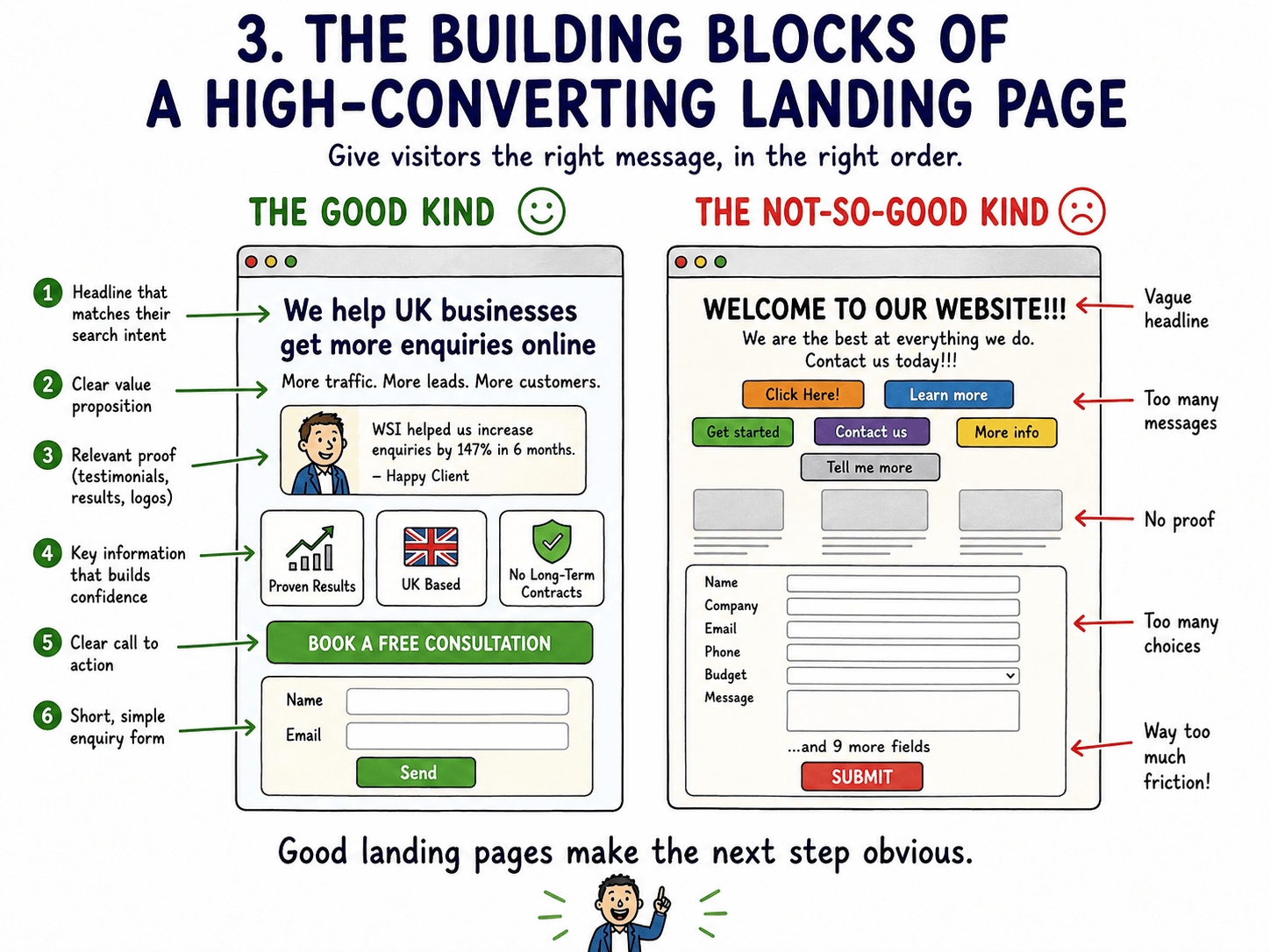
Forms are often where conversions are lost. A form that asks for too much information too early, or that appears before the visitor has been given a reason to trust you, will see low completion rates regardless of how good the rest of the page is.
Calls to action should be specific rather than generic. “Get a free website review” performs differently from “Contact us” because it tells the visitor exactly what they are getting. The language, placement, and visual weight of a call to action all affect whether it gets clicked.
The final step in the conversion process should be the easiest part of the experience. Any unnecessary complexity at this stage, whether that is a multi-step form, a slow-loading page, or a lack of confirmation that the submission has been received, creates a reason to abandon.
For service businesses, this often means reducing the number of fields in an enquiry form to the minimum needed to have a useful first conversation. For e-commerce, it means reviewing the checkout flow for steps that add friction without adding value.
For those that have ecommerce websites you may like to check out my page about how to increase ecommerce sales.
Most visitors who leave your website without converting are not gone permanently. Many are still in a decision-making process and can be brought back into the funnel with the right approach at the right time.
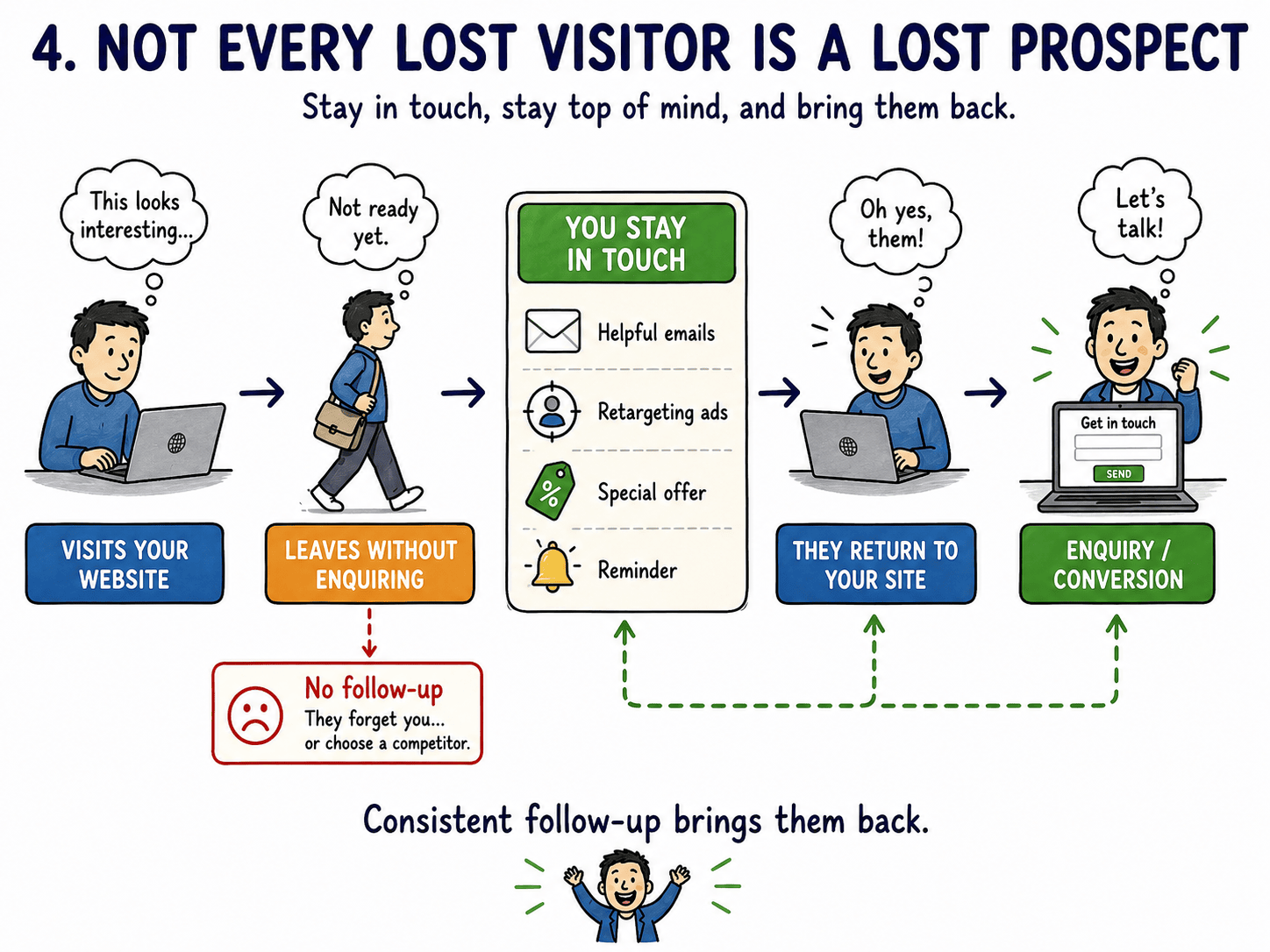
Email sequences are a practical way to stay present with leads who have shown interest but have not yet taken action. When tied directly to website behaviour, such as a visitor downloading a guide or spending time on a pricing page, they are more relevant and more likely to be read.
The role of email at this funnel stage is not to push for an immediate sale. It is to provide useful information that keeps your business in consideration while the prospect works through their decision. Sequences that are too frequent or too promotional tend to produce unsubscribes rather than conversions.
Retargeting allows you to show ads to people who have already visited your website, keeping your business visible during the period when they are still deciding. This is particularly useful for B2B funnels where the decision cycle is long and competitors are also visible.
The most effective retargeting campaigns are segmented by behaviour. Someone who visited a specific service page should see an ad relevant to that service, not a generic brand message. This level of relevance improves click-through rates and brings people back to the right part of the funnel rather than the homepage.
Google remarketing (via Google Ads) is one of the most well-known retargeting systems that allow you to have ongoing visibility of your brand at no cost, and very low costs per click for those that do click back through to your website. Google Ads overall can have a bad reputation, but in my experience, using Google remarketing to ‘follow’ your website visitors with ads is very much recommended.
For prospects who are interested but not yet ready to commit, a low-risk entry point can be the step that keeps them in the funnel. Free trials, demo requests, and no-obligation consultations all reduce the perceived risk of taking the next step.
These work because they shift the ask from “buy now” to “find out more.” For service businesses in particular, a short discovery call or a free initial review can be the bridge between a warm lead and a paying client.
Improving your funnel is not a one-time project. The businesses that see consistent results over time are those that treat funnel performance as an ongoing discipline rather than a periodic fix.
Automation allows you to deliver the right message at the right funnel stage without manual intervention every time. Email sequences triggered by website behaviour, lead scoring updates based on engagement, and automated follow-up reminders all fall into this category.
The value of automation is not speed for its own sake. It is consistency. A lead who enquires on a Friday evening gets the same quality of response as one who enquires on a Tuesday morning. That consistency protects conversion rates across the full week, not just during working hours.
A/B testing is the process of running two versions of a page, form, or call to action simultaneously to see which performs better. It removes opinion from the conversation and replaces it with data.
The discipline here is to test one variable at a time and to run tests long enough to produce statistically meaningful results. Testing a headline change on a landing page for three days with low traffic will not tell you much. The same test run over several weeks with sufficient visitor numbers will.
Optimizely, while ideally wanting people to try their system, do have a great article that explains A/B testing in more detail.
Where a business has both a marketing function and a sales or client-facing team, misalignment between the two is a common source of funnel inefficiency. Marketing may be generating leads that the sales team considers unqualified. The sales team may be following up in ways that contradict the messaging the lead has already received.
Closing that gap means agreeing on what a qualified lead looks like, sharing data on which leads convert and which do not, and ensuring the handover from digital touchpoint to human conversation feels consistent rather than jarring.
The fastest improvement usually comes from fixing the bottom of the funnel first. Reducing friction on your enquiry form or improving the clarity of your call to action on a high-traffic page can produce measurable results quickly, without requiring new traffic or a full rebuild.
The clearest signal is a gap between traffic levels and conversion rates. If your website is receiving a reasonable number of visitors but generating few enquiries, something in the funnel is breaking down, and your analytics data will usually show you where.
A light review of key funnel metrics monthly is a reasonable baseline. A more thorough audit, looking at page performance, drop-off points, and conversion rates across the full journey, is worth doing quarterly or whenever you make a significant change to your website or campaigns.
Knowing how to improve your sales funnel comes down to three things: understanding where visitors are dropping off, fixing the specific friction points causing that drop-off, and testing changes with real data rather than assumptions. Start with your analytics, focus on the bottom of the funnel first, and build from there. If you would like a clearer picture of where your own funnel may be losing conversions, get in touch with me for a no-obligation website review.