
Most advice about LinkedIn concentrates on what you should post.
Create better content. Post more often. Use video. Comment on other people’s posts. Get more engagement.
All of those things can help.
But there is another part of LinkedIn marketing that I think many businesses overlook:
How many relevant people are actually connected to you in the first place?
You can spend hours creating an excellent article or LinkedIn post, but if you have only built a relatively small network around yourself, you are limiting the potential audience LinkedIn has to work with.
LinkedIn certainly doesn’t show everything you publish to everyone who follows you. Far from it. Its feed decides which posts are likely to interest individual users, and the reach of two apparently similar posts can be remarkably different.
But that doesn’t make follower numbers irrelevant.
Every relevant person who becomes a first-degree connection will normally follow your posts as well, unless they subsequently choose to unfollow you.
So every time you add another genuinely relevant connection, you are potentially adding another person LinkedIn can consider showing your future content to.
And this isn’t something reserved for people paying a lot of money for LinkedIn.
You can start doing it with:
The options available to you differ, particularly when it comes to finding people and adding a message to your connection request, but the basic strategy works at every level.
The objective is simple:
Find relevant people. Connect with them consistently. Build the audience around your business over time.
And ultimately, give more of those people a reason to find their way to your website.
It is worth clearing up one misconception first.
Having 5,000 followers does not mean LinkedIn will show your next post to 5,000 people.
It might show it to a small proportion of them. It may also show the post to people who don’t follow you at all.
LinkedIn has increasingly moved towards an interest-based feed, where it tries to work out what a piece of content is about and which people are most likely to find it relevant.
Independent research by LinkedIn specialist Richard van der Blom, based on 1.3 million posts and more than 80,000 profiles, found that approximately half of the variation in post reach was associated with what he describes as the creator’s existing “profile baseline” – including follower base, historical engagement and topic consistency. The performance of the individual post was another major factor. This is independent research rather than an official LinkedIn formula, but the finding is useful.
In other words:
The post matters, but so does the audience and reputation you have already built before you publish it.
That is why I think businesses should work on both.
Keep creating useful material.
But at the same time, keep increasing the number of relevant people who might encounter it.
You’ll see two different numbers on LinkedIn: connections and followers.
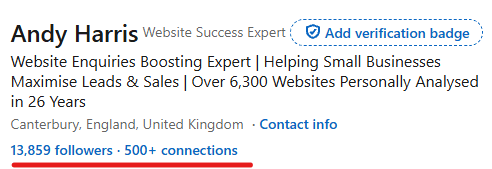
A connection is somebody with whom you have established a first-degree relationship on LinkedIn.
In my case, it’s close (13,850 connections).
I know what you’re thinking – oooh, that’s quite a few connections – he must be doing a good job.
No!! Look at when I joined:
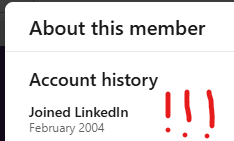
13K connections in 22 years is NOT good!
I remember the days where you could go to an expo in London and meet LinkedIn people on a 3×3 metre stand – it was that small and yes, you could actually talk to people there!
But somehow I failed to focus on my connections for so many years.
Followers are people who can receive your content in their feed. Your connections will normally follow you automatically, but someone can also follow you without becoming a connection.
For most business owners following the strategy in this article, the important thing is that when someone relevant accepts your connection request, you’re normally doing two things at once.
You’re expanding your professional network.
And you’re potentially expanding the audience for what you publish in future.
That is why I don’t see connection building as being separate from content marketing.
The two support each other.
Occasionally a LinkedIn post takes off.
I have seen this myself.
One of my posts generated more than 5,000 impressions. At one stage, LinkedIn’s analytics showed that 93% of its impressions were coming from outside my existing network.
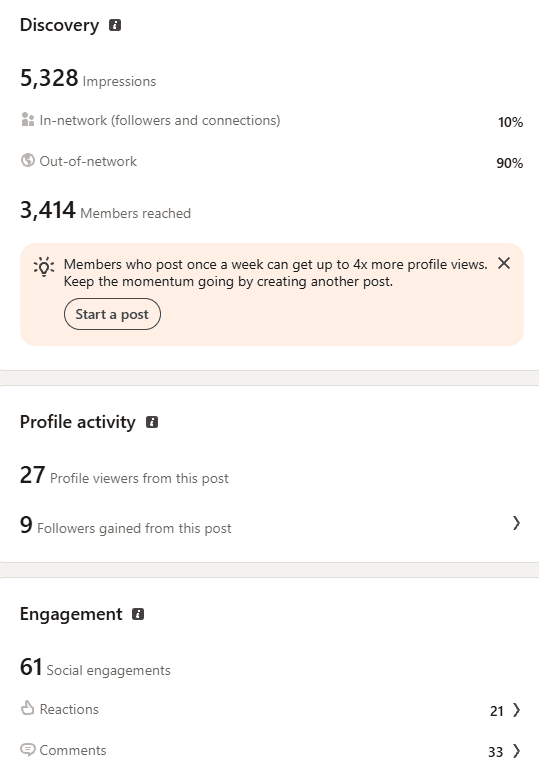
The post had turned into a proper conversation involving people beyond my normal audience, including a very clever lady well worth following (shout out to Alicia Teltz) with a substantial LinkedIn following of her own.
That kind of breakout reach is useful when it happens.
But it isn’t something I would build a marketing plan around.
The better objective is much less exciting:
Steadily build a relevant audience, publish useful things for them and allow occasional posts to travel further when LinkedIn decides there is wider interest.
You cannot control the reach of every post.
You can control whether your potential audience is getting bigger.
This is where people sometimes assume they need an expensive LinkedIn subscription before they can do anything meaningful.
You don’t (although it still can help).
Here is the practical difference for the strategy we’re discussing.
| LinkedIn account | Can send connection requests? | Personalised notes | Useful for this strategy? |
|---|---|---|---|
| Free / Basic | Yes | Very limited | Yes |
| Premium Business | Yes | Unlimited within your connection-request allowance | Very useful |
| Sales Navigator Core | Yes | Unlimited within your connection-request allowance | Very useful, with better prospecting tools |
There isn’t an official published figure saying that Premium or Sales Navigator users get a larger weekly allowance of standard connection requests.
LinkedIn says that invitation restrictions can apply to both Basic and Premium members.
So don’t buy Premium Business because you think it gives you hundreds of extra connection requests.
The advantage for this particular strategy is elsewhere.
You can still do nearly everything this article is asking you to do.
Search LinkedIn for relevant people.
Look at who they are.
Send sensible connection requests.
Do a manageable number regularly.
And gradually increase your network.
The biggest limitation is personalised connection messages.
At the time of writing in September 2026, LinkedIn’s guidance says Basic users can add a personalised note to only three connection invitations per month, while Premium accounts can add personalised notes without that restriction. Connection-request limits themselves can still apply.
So if you use LinkedIn for free, most of your invitations will simply have to be standard connection requests.
That’s a bit shit, but isn’t a reason not to do it.
It simply means you need to be particularly sensible about whom you approach.
If the recipient can immediately understand why somebody in the same town, profession or industry might reasonably want to connect with them, the request makes much more sense than a completely random invitation from somebody on the other side of the world.
Premium Business becomes interesting because you can give people some context.
LinkedIn currently lists Premium Business in the UK from £49.99 per month when paid monthly, or £359.88 per year, although prices can change and LinkedIn says VAT and promotional variations may apply.
For the strategy I’m describing, one of the important differences is the ability to add personalised notes to your connection requests.
That’s useful because a stranger receiving this:
Andy Harris would like to connect
… has no real idea why I want to connect.
Compare it with a short message explaining that I’m involved in a local business, I’m trying to become better connected with other local businesses and I’m not going to immediately start bombarding them with sales messages.
That provides context.
It doesn’t guarantee they’ll accept.
But at least they know why the request has arrived.
Sales Navigator takes the prospecting side considerably further.
The current UK starting price for Sales Navigator Core is £94.99 per month or £959.88 annually, before possible VAT, discounts or account-specific pricing.
It provides considerably more sophisticated ways of identifying people and companies you may want to know.
Ironically, I have Sales Navigator myself and probably don’t make anything like as much use of its dedicated functionality as I should.
Yes, I know – idiot!
But you don’t need Sales Navigator simply to follow the networking habit I’m describing here.
Its value becomes greater when you want to be much more precise about identifying the kinds of people and companies you want to reach.
This is far more important than simply chasing a large follower number.
I wouldn’t recommend trying to collect thousands of completely unrelated LinkedIn connections.
Think about who could realistically become part of the audience around your business.
For example:
In my own case, I wanted to become much more connected to businesses locally.
So I built a large working list of relevant local people and started gradually connecting with them.
The principle wasn’t sophisticated.
They run or work within a local business.
I run a local business.
There is a perfectly reasonable reason for us to be connected.
And importantly, I wasn’t treating every new connection as somebody who should immediately receive a sales pitch (more on that messaging further down).
This is probably the single most useful part of the strategy.
Don’t sit down one Friday afternoon and try to send hundreds of connection requests.
Make it routine.
In my case, I have historically worked around:
20 connection requests per working day
which gives:
20 × 5 days = around 100 connection requests per week.
LinkedIn does not publish an official rule saying everybody is allowed exactly 20 per day or 100 per week.
Limits can vary, and LinkedIn may restrict an account if it detects unusually high activity, large numbers of ignored invitations or behaviour it considers problematic.
So I wouldn’t treat 100 as a target you have to hit at all costs.
It’s simply a useful illustration of what a consistent routine might look like.
Ten a day would still be 50 a week.
Five a day would still be 25.
The important part is doing it repeatedly.
Imagine you build a routine of sending relevant connection requests and ultimately add just 10 new relevant connections per week.
That’s roughly:
500 additional connections in a year.
At 20 a week:
approximately 1,000.
At 30:
approximately 1,500.
I’m deliberately not suggesting a connection acceptance rate here because it can vary enormously depending on the person, market, relevance of the request and how established the LinkedIn profile looks.
But the compounding effect is obvious.
Even fairly modest weekly growth becomes substantial when you keep doing it for a year or two.
If LinkedIn gives you the option, then yes, context is useful.
As mentioned earlier, free LinkedIn users currently have only a very small number of personalised invitations available each month, so don’t worry if most of your requests have to go out without one.
Premium Business and Sales Navigator users have much more flexibility here and if you do it right, the cost pays for itself over time.
My own message has been along the lines of:
Hi [Name], I’m involved in a local business and I’m looking to connect with more businesses in the area. It would be great to connect – and don’t worry, I’m not going to connect and then start spamming you!
It isn’t clever copywriting.
It doesn’t need to be.
It tells the recipient why I’m contacting them and, importantly, addresses something many of us think when an unfamiliar LinkedIn request arrives:
What are they going to try to sell me?
But there is an important second part to this strategy.
If you tell people you’re not going to spam them…
don’t spam them (and I don’t).
In most cases?
Nothing except to thank them for accepting your request.
At least not immediately.
I know that’s almost the opposite of some LinkedIn lead-generation advice.
I’m not trying to turn every connection into a sales funnel.
The value is that a tiny part of a relationship now exists.
Over the following weeks and months they may see:
Eventually they may recognise my name.
At some point they may visit my website.
And one day they may need help with something that I do.
That is a very different relationship from:
Thanks for connecting. Can I have 15 minutes in your diary next Tuesday?
Yawwwwwnnnn – we’ve all seen those.
I know which approach I’d rather receive.
This is exactly what I did.
I knew that telling myself:
“Every day I must remember to find 20 suitable people and send connection requests”
… would probably work for a while and then gradually disappear behind client work.
So I delegated the routine.
A virtual assistant can work through an agreed group of relevant people and carry out the connection process for you.
That doesn’t mean handing your LinkedIn account to the cheapest anonymous person you can find.
You’re potentially giving someone access to an important business profile, so you need to know who you’re working with, trust them and consider the security implications of giving anybody access to your login.
And you should keep the activity sensible rather than attempting to automate hundreds of requests.
But commercially, delegation can make a great deal of sense.
If your own time is worth considerably more than the cost of having somebody carry out a small, repetitive task, there isn’t much value in insisting that you personally press every button.
In my case, what mattered was that the routine happened consistently.
You could equally do it yourself.
Twenty connection requests needn’t occupy much of the day.
The question is simply:
Will you actually keep doing it?
If the answer is no, delegating it may be the difference between a good intention and a network that genuinely grows month after month.
How much do I pay for that?
100 connection requests per week = £20 per month cost. It’s nothing vs the value of my own time.
There is an important qualification to everything I’ve written so far.
Increasing your follower count doesn’t mean every post will suddenly perform brilliantly.
LinkedIn’s feed doesn’t work that way.
A relatively small account can produce something that generates huge engagement.
A much larger account can publish something useful and receive surprisingly little attention.
Sometimes the material that performs best isn’t necessarily the material you consider most commercially important either.
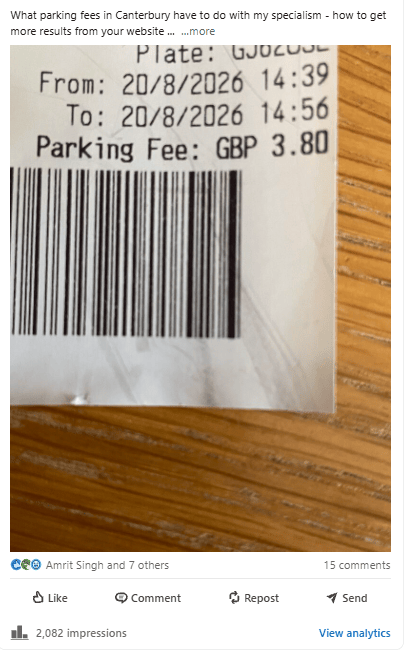
I once posted something about a £3.80 parking charge in Canterbury.
It generated more than 2,000 impressions and considerably more conversation than some technically-useful marketing posts I’ve published.
Why?
Parking is relatable.
Almost everybody has an opinion about it.
It is immediately understandable and easy to respond to.
A detailed post about web analytics might be enormously valuable to the right person, but the relevant audience is naturally much narrower.
So don’t confuse:
larger audience
with:
guaranteed engagement.
The point of building your network isn’t that LinkedIn must show your posts to everybody.
It’s that you’re steadily increasing the number of relevant people with whom LinkedIn can potentially match your content.
And occasionally, something travels far beyond that audience.
That’s where things can become particularly interesting.
For me, this is the most important part.
I’m not trying to become a LinkedIn influencer (although admire those who are).
My business is about helping companies get more from their websites.
A large part of my own marketing revolves around producing useful information on my website and then using channels such as LinkedIn to get that knowledge in front of more people.
Sometimes I’ll put the link directly into a LinkedIn post.
Sometimes I won’t.
Sometimes the LinkedIn post will simply be a condensed version of the idea.
That’s fine.
Not every LinkedIn interaction has to result in an immediate click.
Someone might see several things from me over six months before they ever visit my website.
But when the time comes that they need help increasing enquiries, understanding their analytics, improving conversion rates or making their website perform better, I want there to be a reasonable chance that they know who I am.
That is what the connection-building activity contributes to.
You’re building familiarity.
You’re increasing your potential distribution.
And you’re giving more relevant people opportunities to encounter the useful material that sits behind your business.
You don’t need a complicated system.
Start with this:
That’s the part people underestimate.
A few connection requests today don’t make much difference.
A few every working day for two years can.
There is very little value in having 20,000 followers who have no interest whatsoever in you, your business or the things you write about.
I’d rather have a smaller audience containing the right people.
But if those right people number 500 today, why couldn’t they number 1,000 next year?
Or 2,000?
Or 5,000?
Businesses put enormous effort into creating content and trying to get noticed online.
It makes sense to put some effort into building the audience that content is being created for.
So by all means work on your next LinkedIn post.
Think about the opening line.
Use a good image.
Create a useful video.
Write something worth reading.
But also ask yourself a much simpler question:
How many new relevant people did I connect with this week?
Because the audience you build today could be the audience that sees your content, visits your website and eventually becomes a customer months or even years from now.