
If you don’t have a pricing page on your website then you will lose potential enquiries.
However, it’s not always necessary to show your actual pricing – what’s important is to assess how important pricing information is to your website visitors.
This guide about case studies focuses on proving how good you are, so that visitors to your website have plenty of reasons to make contact about your products or services.
Here I focus on another reason that stops potential customers from making contact with you:
Pricing.
You may already be having some of these thoughts:
All those points are valid.
They also stop you gaining new enquiries.
Their primary thoughts (beyond evidence that you have impressed many other customers) will be:
If you walked into a shop and saw shelves of products and no pricing, what would you be thinking?
Would you ask someone how much something costs?
Or would you go to the shop next door that has the same products with prices on them?
When you look at your website visitors data of people who get to specific product or service pages, ask yourself these questions:
One big blockage that stops you getting website enquiries is a lack of clarity on pricing.
When people are interested in a product or service, but can’t see anything about pricing, it says to them:
“We are hiding the price from you because it may put you off making contact with us, so we hope that you will contact us anyway, so that we get an opportunity to sell to you”.
So here’s what happens: many people won’t make contact if the website seems to be hiding pricing information.
Many websites assume (incorrectly) that if they offer demos then people will sign up to them.
Their thinking is flawed because most people won’t sign up for a demo if they have no idea what the product or service is going to cost them, and they don’t want to invest time on a demo if they then may discover that the pricing is beyond what they are prepared to pay.
Those that offer demos thinking that they’ll convert those people to paying customers will gain a few demo requests but will lose the majority – purely because they haven’t been transparent about costs of the product or service.
Here’s the good news: you don’t have to show your actual pricing on your website …
… although this recommendation may get you changing your mind about that over time!
It’s vitally important to gain a better understanding of the reasons why you don’t get more enquiries about specific products or services offered on your website.
Lack of pricing information could be one factor.
Follow these steps to create a simple structure that will help aid your thinking on the subject of pricing …
Create a generic ‘Pricing’ page within your website. It only needs to be one page but it needs to be highly visible in your main navigation bar, so that people can always click on it from wherever they are on your website.
With that in mind, it’s worth checking that your navigation bar stays visible as people scroll down your website pages (so that they can always see pricing visible).
Within that pricing page create one or two paragraphs that are as limited or expansive as you are comfortable with.
Here’s an example of text that could go on a very limited pricing page:
Thank you for visiting our pricing page.
All our services are bespoke to your specific requirements – please do contact us so that we can focus on how your investment in us will exceed your expectations.
And here’s an example of pricing page text that goes a little further:
Thank you for visiting our pricing page. The nature of our service is that every customer has different requirements, each of which has different pricing.
Below you will see several examples of projects we’ve worked on. The customer details aren’t shown due to confidentiality agreements, but we have shown the sizes and sectors of those businesses.
Under £1,000 investment
[Several examples of work done for that price range.]
£1,000 – £2,000 investment
[Several examples of work done for that price range.]
£2,000 – £5,000 investment
[Several examples of work done for that price range.]
£5,000 – £10,000 investment
[Several examples of work done for that price range.]
Within your product or service pages, create highly visible graphics that encourage people to click through to that one pricing page.
For example, a graphic that says:
See pricing information.
Ensure that whatever product or service page people are viewing, it’s very clear that they have the option to click through to your one pricing page.
You may think that it’s enough to have text links to your pricing page.
Text links are better than nothing, but not good enough – you need graphics that jump out.
The objective of having a pricing page (and clear opportunities for website visitors to click through to it from your product or service pages) is for you to achieve this:
Using a hypothetical example, before the presence of a basic pricing page, this could be the situation:
After creating a pricing page and calls to action to click through to it, here’s what happens:
The overall point of that pricing page is for you to get a very clear picture that pricing is a subject of importance to your potential customers, even though you are not (at this stage) giving specific pricing information about individual products or services.
That then gets you thinking about …
If you have a basic pricing page that people are clicking through to, then you know that pricing is important to them.
Whether you created a very basic pricing page message or expanded further, your enquiry levels will tell you that you could be achieving more.
One method that gets amazing results is to summarise the pricing for each service/product you offer. Here’s an example, followed by explanation of why it works:
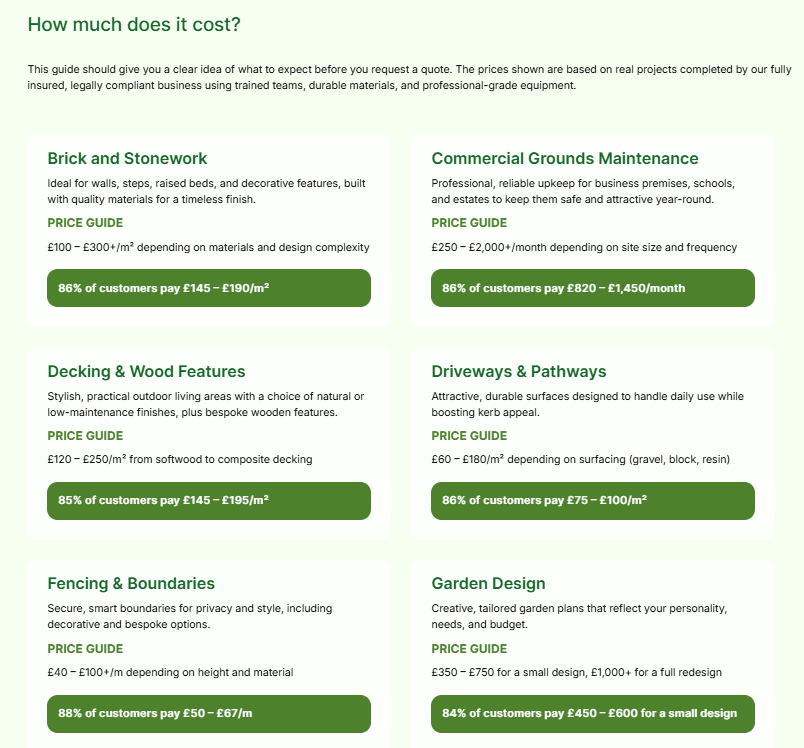
Each service is briefly described and includes an overall price range people would expect to pay for the service.
The genius part is including the extra part that shows a high percentage of customers paid within a tighter price range.
Taking that example above, while the overall range for decking is £120 – £250 per square metre, 85% of customers (the significant majority) paid between £145 – £195. Most people reading that will hope/think that they fall within that (majority) tighter price range and so will make contact.
Does it work?
Hell, yes!
For that client, since the introduction of that pricing page, 68% of their enquiries were from people who had visited their pricing page as part of their website visit. In real terms: £hundreds of thousands of work quoted over a few months that wouldn’t have been gained without that pricing page.
If your business is able to show pricing, then that’s always going to be the best approach because potential customers will appreciate your transparency.
The compromise is as I’ve already covered: to include some examples of price ranges and what was supplied within those price ranges.
Your product or service pages should be answering these two important priorities of the potential customer:
When you’ve answered those questions, any lack of conversions to enquiries can be focused on what else may need to be strengthened within your website pages.