
The short answer:
There are two things foremost in the minds of people who visit your website:
Point 2 is covered in this guide.
Point 1 is covered here …
Let’s talk about YOU for a minute …
What is it that YOU are looking for when you go to various websites?
It’s quite likely that, before you look deeper into the product/service on offer, you are most interested in;
You don’t want to make a buying mistake so are looking for enough reassurances and information for you to consider making contact.
If your website doesn’t significantly focus hugely on case studies then you’re leaving the door wide open for competitor websites that do.
It’s the single biggest problem with business websites, and has been for decades.
You may see websites that have a case studies or testimonials section, normally visible within the main navigation bar.
It’s better than nothing, but in the majority of cases, isn’t enough.
Why aren’t they good enough?
Because they normally contain a varied collection of case studies/testimonials.
For example, an engineering firm makes plastic widgets, metal widgets, red widgets, and blue widgets.
They have a case studies page that has a range of case studies covering a range of the products that they produce.
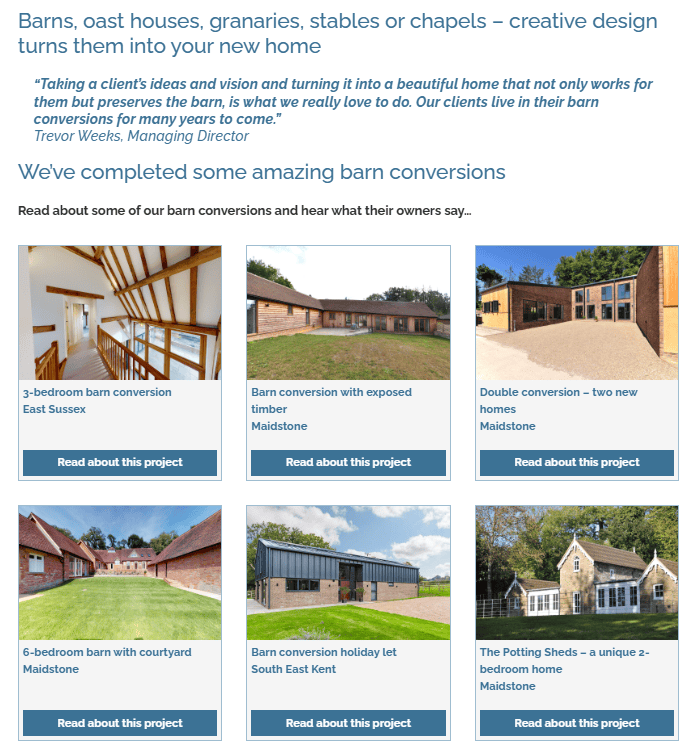
That would be OK if they allowed the website visitor to filter the page to display only products related to what they’re interested in, but most don’t do that – most websites purely offer several case studies lumped in together. Like this one:

What that shouts out to the website visitor is:
“We don’t respect your time because we’re hoping that you will scan through our case studies, picking out those that are of interest to you”.
It also doesn’t think deeply enough about how to impress the website visitor, who has a service or product in their minds and has no wish to click through loads of case studies just to find ones that relate to what they want.
Testimonials are easy to fake, especially if they are not attributed to a named person from a named business.
Case studies are also easy to fake but they generally refer to a business, sometimes a named person, and they wouldn’t be allowed to stay online for long if that business picked up that they were fake case studies.
Case studies also provide the opportunity to go into more detail about the product/service provided, which will interest people more than a list of testimonials.
While there’s nothing wrong with having a page of testimonials within a website, and to include those within specific product/service pages, they will never be as powerful as detailed case studies.
Each product/service page of your website needs this structure:
That structure says to the website visitor:
Some websites have case study excerpts lower down the product/service page but that’s not good enough.
They need to be much higher up the website page structure, because they are what’s needed to impress people to engage with the page and your business.
The answer to this is simple: the more you’ve got, the more positive the impact.
The best option on your product/service page is to have 6-9 case study excerpts (typically displayed three across the page and three rows deep), and below those have a button that says:
See more case studies (which then loads the additional case study excerpts into the page).

Even better than that would be a button that has a number in it that can create more reason to click, with a call to action, such as:
See 10+ more case studies.
Three case studies would be the minimum – any less than that and it will create an impression that you haven’t performed well at that product or service.
Three is OK.
3-6 is better.
6-9 is even better.
A ‘See X+ more case studies’ button will get even more people interested because they will look at that number (e.g. 12) and even without clicking on the button they’ll think:
“Wow – they’ve got another 12 case studies – they must be good!”
Here are some common, and sometimes valid objections to creating case studies that are visible for all to see:
The more you are able to name your customers in your case studies, the more enquiries you will get.
Naming customers makes it very real and less likely to have been faked.
So what do you do when you’re in a position where you genuinely can’t or won’t (because of competitors seeing them) use the name of your customer in a case study?
You may find it workable to make the case study anonymous. For example: A food production business in the North West.
As long as you make it clear why they are anonymous, and the case study is clearly genuine, then it will be better than having no case study at all.
You could, for example, use text similar to this at the start of a case study:
Although we prefer to show our customer names, this case study is anonymous due to the confidentiality agreement with our customer.
People will understand the reasons for that, and it may also work in your favour if the prospect customer are considering using you but want that same confidentiality preserved for their own business.
There are a few steps to this, best undertaken over a period of time …
You may be thinking at this stage: “but surely we need to get permission from our customers before we create these case studies?”.
That may be the case, but often it’s not.
Unless you have strict rules that you have to work within (e.g. agreements with your customers), then what’s to stop you creating case studies from your perspective of how you impressed those customers? This is especially true for those that are no longer customers (you’ve worked for them in the past).
Here’s an experiment very much worth running:
You’ll likely be pleasantly surprised that few of your customers are actively looking for what people are saying about them and even if they are, those that object to it would be relatively low (and you can always blame it on someone else before removing their case study if they really don’t want it live).
What’s worse? …
It’s worth repeating this important point: if you don’t have case studies, then you will get much fewer enquiries from your website visitors.
Although opinions differ on this point, so it’s worth consulting your website developer to get their viewpoint.
One place for your case studies to live is within a section of your website dedicated to case studies, but sub-divided into what they relate to.
For example:
/case-studies/red-widgets/case-study-a
/case-studies/red-widgets/case-study-b
/case-studies/blue-widgets/case-study-c
/case-studies/blue-widgets/case-study-d
The case study excerpts on your product/service pages would then link to where the actual case studies live within your structure.
This keeps your case studies very tightly within the product or service structure of your website.
/widgets
/widgets/red-widgets
/widgets/red-widgets/case-study-1
/widgets/red-widgets/case-study-2
/widgets/red-widgets/case-study-3
/widgets/red-widgets/case-study-4
None of this has to be done manually of course – your web developer will know how to make it so that you create case studies and have excerpts of them automatically appear within the relevant product/service parts of your website.
Obviously, the best way to see how impactful your case studies is by you gaining more enquiries and sales.
From a statistics viewpoint, you can use software to track how many of your website visitors get to your case studies from your product/service pages.
Here’s a video example of how that can be done by using the software I recommend (initially, via a 30 day free trial), showing how 26% of a specific type of website page visitors clicked through to case studies related to the topic they were interested in:
If you have an enquiries logging process within your business then you will be able to link enquiries gained back to those website visitors. If using the software (let me know if interested in trialling it free for a month) it will be very easy to see evidence that your case studies played an important role in making that happen.
That in itself will give you plenty of incentive to create even more case studies so that people have even more reasons to make contact with you about the product/service that they’re interested in.
When you have plenty of case studies within each product/service part of your website, you can go one valuable step further – focusing on industry sectors.
The only difference here is that when someone is viewing the part of your page that shows the case study excerpts, it also gives them the option to filter by industry sector so that they see only case study excerpts related to their industry.
That will require you to have plenty more case studies but it will further increase your levels of enquiries when you can provide case studies that are highly relevant to where those people work.