
There aren’t many software solutions that enable you to see which residential properties have been to your website.
The software I use is something that you can try free for 30 days in combination with the follow up methods I cover on this page.
First, the bad news …
You can’t identify ALL residential visitors going to your website.
Now the good news …
You CAN identify anything from 10-30% of visitors as being from residential locations (based on over 600+ customer use cases that I’ve personally been part of).
You install a piece of tracking code on your website (which is sent to you from Who Visits My Website).
Installation is easy – a two minute task for the person who manages your website.
When visitors go to your website they will see a box pop up similar to this:
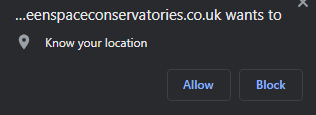
If they choose Block then you can’t track their location.
If they choose Allow (which 10-30% of people do) then they will be geolocated to where they were at the time they went to your website.
Geolocation works in two ways:
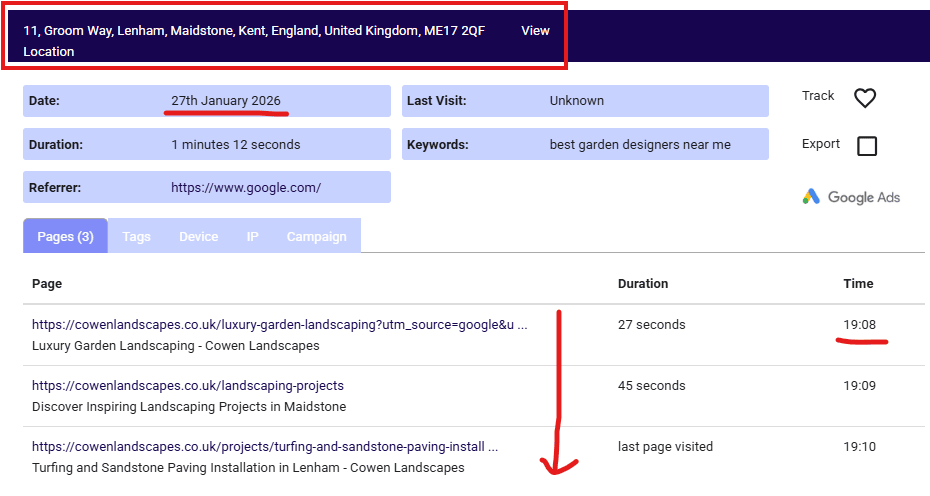
Here’s an example of someone identified by a specific address:
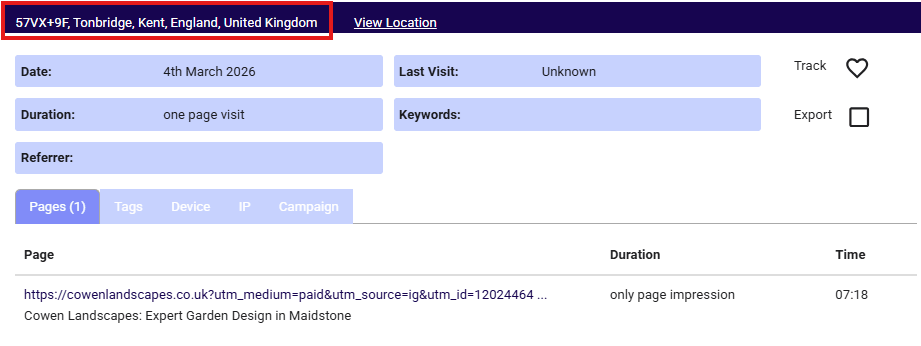
Here’s an example of someone identified by geolocation without a street address (these are less frequent):
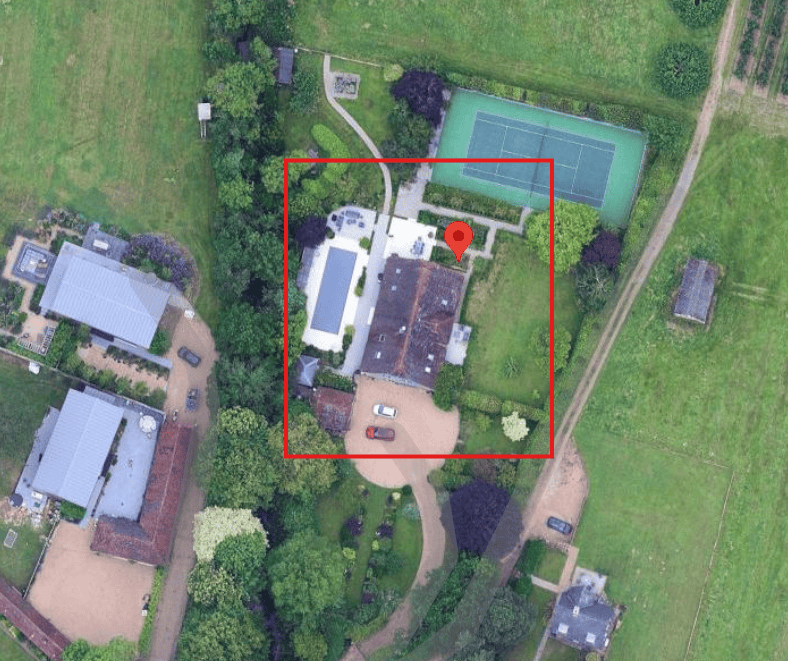
You may wonder how useful that is without the address showing, but you can look up that location on Google Maps, which will show you exactly where the visitor was:
Here’s some more information about how geolocation can be used with Google Maps.
Sometimes it’s perfectly accurate and sometimes it’s not.
It depends on a range of factors.
The most accurate geolocation happens when people are using mobile devices and some desktop geolocated people are easier to geolocate than others (depending on their internet provider).
My advice is to utilise data for free and, when you get results from your outreach activity (to the residential properties you’ve identified), build up a picture of which types of geolocated visitors were more accurate than others.
This business identifies residential areas that go to their website and then uses Google Maps to check that the house has a conservatory before posting a glossy brochure to that house (that they know has an interest in having their conservatory roof replaced).
Identifies people who get to their website wealth management pages and then looks up those addresses to check that they live in areas most likely to have wealth to manage.
They then hand-post introductory letters to the house identified, plus also other houses surrounding it.
Most chiropractors get repeat business and referrals onto new clients, so it’s worth them seeing which houses have been to their website, and what they looked at.
They then send a covering letter plus individual pages of testimonials related to the kind of pains people were looking at on their website.
A wedding venue is a high cost for the happy couple and so most people do a lot of research to find the right venue.
This wedding venue business knows they need to stand out and, after they’ve identified someone from a house has been to their website, they send a very nice pack to that house, including complementary chocolates to eat while looking through the brochure.
Their competitors are not identifying visitors to their website and so lose business to their proactivity.
This solar panel installations business spends on paid advertising to get people to their website.
They identify an average 27% of visitors as being from their residential addresses and they use Google Maps to check which houses in the area haven’t already got solar panels.
They then get brochures hand-delivered to houses in that area that haven’t already got solar panels.
These mortgage advisors identify the pages of their website that geolocated residential visitors visited.
Being a local business, they are in a position to hand-post information packs through the letterboxes of houses that they have identified.
Those packs contain information related to what the person (from that house) was looking at on their website (e.g. remortgaging, first time buyer).
The video below shows you an example of how a conservatory roof replacement business uses geolocation.
To clearly see the detail within the video, please do click on Full screen or the Watch on YouTube options (which both appear on the right after you press play and hover over the bottom of the video).
Each business will use a different range of methods to capitalise on the visit to their website, so this is just one example of how that’s done.
Ideally, people go to your website and they will contact you.
However, there are reasons they don’t, including:
The answer to all the above is to send something impressive to their residential location.
Why?
Because it’s unlikely that your competitors will be doing that (so you stand out).
For those who went to your website researching options, your posted communication can be enough to make them respond to you, and sometimes to share with other people who are part of that decision-making process.
For those that didn’t get enough of a good feel from your website, what you send them could be enough to turn that around in your favour.
Unfortunately, although you can identify the residential location of the visitor to your website, you won’t know who it was within that property.
This means that any communication can’t be personalised and so the best you can do is make your communication to them appear to be a coincidence that you happened to be publicising your business at the same time someone at that house was researching what you offer.
There’s a good reason why businesses don’t spend a lot of budget on posting to houses: the spiralling costs of postage.
If you’re a relatively local business then you have the option to hand-post through letterboxes.
If your target area is further afield you only have two choices:
If you’ve gone to the trouble of identifying residential locations that have been to your website, then putting a leaflet through their door may not impress them much.
However, if you are hand-posting to an area, then you could also get leaflets delivered to other properties in that area while someone is physically there.
Also, when considering your future print marketing activities, there are ways to use leaflets in a smart way that gets a much higher return from the initially scattergun approach of leaflets distribution.
A letter introducing you and your company should be brief but impactful.
It would ideally be one page that includes your contact details, and have supplementary information as extra pages.
For example, if someone has been to the website of a chiropractor and looked at pages related to sciatica and back pain then they could receive three sheets of paper:
Sheet 1
This is the covering letter and would include your contact details and be hand-signed. The text would include similar to this:
You may not have heard of us before, but we have been removing pain from customers in this area for over 20 years, and are proud to have the privilege that our customers refer us onto their own friends.
We provide chiropractic care to help in many ways, including:
If you or anyone you know is ever in need of such pain relief, please do contact me via any of my details below.
I’ve also attached just a small selection of testimonials from customers who had previously suffered two types of pain, so that you can see what a difference we make.
Sheet 2
Titled: Testimonials from customers we’ve helped with sciatica.
Several testimonials from customers who have been helped with their sciatica.
Sheet 3
Titled: Testimonials from customers we’ve helped with back pain.
Several testimonials from customers who have been helped with their back pain.
The point of that letter and attachments is that it’s likely to be read by the person in that house who had been to the website looking at sciatica and back pain (either for themself or someone else) and so the testimonial examples will be very topical and hopefully give them enough reason to make contact.
That’s just one example of course. The letter and related content will differ for each industry type but the principle is the same: include information related to what the person in that house/residential location looked at during their website visit.
This goes further than a letter.
It would still have a covering letter that refers to how you have been a great resource for people in the geographical area, but that letter is mainly to provide contact details and introduce the brochure that you send.
That brochure would ideally be very impressive, contain everything someone may need about your service or product, and overall be enough to nudge someone into making contact with you.
You could even add something to the brochure that will impress the potential customer more.
For example, if you are a wedding venue and could potentially get a booking worth £thousands then it could be a good idea to include quality chocolates for people to share while they browse the brochure.
Including postage, brochures (and extras if you include them) do have a cost, but if you are using geolocation then you will be targeting the right properties and will quickly see a return on that investment.
It’s critical to be measuring what you gain from the promotional activity.
Each posted communication that’s delivered needs to be recorded against the original geolocated data that gave you the residential address.
Why?
So that you can measure good results and poor results.
For example, you send 100 brochures by post and you get 20 enquiries.
Each enquiry will have an address associated with it, which you can link back to the original geolocated data (and also the original source of the visitor to your website (e.g Google Ads), so that you can see what led to the geolocated targeting and ultimately to the enquiry you gain).
For those brochures that didn’t gain enquiries, you’d compare that to the geolocated data to identify if there’s a need to refine which types of geolocated visitors you do send to. For example, the geolocated data may tell you that people on desktop computers using a specific internet provider don’t respond as well as those who were on mobile devices, which could indicate that geolocated data isn’t as accurate for some internet providers.
There will be patterns in the data (and it’s something I help my customers to identify) and so your starting point is to ensure that you keep accurate records of all data related to the promotional materials you send to people.
Using the software I recommend, you can test this out free for 30 days.
Here’s how …